As Seen In
Articles related to Love Me Don’t Leave Me:
No Partner? How to Celebrate Valentine’s Day
by Michelle Skeen, PsyD, author of Love Me, Don’t Leave Me
eharmony
Most of us associate Valentine’s Day with romantic love, often making February 14th a difficult day for those who are unpartnered. Unfortunately, for some the holiday is a reminder of past hurts, grief, and rejection. It’s time to focus on the present and take a new perspective on Valentine’s Day.
Here are some tips for celebrating Valentine’s Day, embracing the love that is all around us, and sharing the love that we have to give:
1. Use this as a day to show appreciation and love to friends and family. Valentine’s Day shouldn’t be restricted to romantic love. Make February 14th a day to celebrate the people in your life who matter to you. You might express your feelings by writing a card, making a telephone call or giving a meaningful gift.
2. Engage in random acts of kindness and expressions of love. Reach out to people who you might see with regularity but don’t know personally—the doorman or janitor at your office building, your coffee barista, the homeless person who sleeps on your block, the bus driver, the staff at your gym or anyone whose very presence makes your day a little brighter or makes you appreciate what you have. Carry around individually wrapped chocolates to hand to these people throughout the day or make little cards that have an inspirational message (e.g. “you are loved”) that you want to share.
3. Make a plan to celebrate with friends. If this day is particularly painful for you then plan to do something with a friend. You might want to go to an exercise class, go on a walk or hike, make dinner together, see a movie or any other activity that you both enjoy.
4. Volunteer. Getting outside of yourself and sharing yourself with others who are less fortunate makes everyone feel better. Serve a meal at a soup kitchen, visit residents at an assisted living facility, go to an animal shelter and share affection with the cats and dogs who don’t have homes. You will be connecting with others in a meaningful way.
5. Show love toward yourself. This might mean indulging in a massage, a facial or a manicure/pedicure. Or, if cost is an issue you can give yourself a DIY facial mask and a bubble bath. Pick something that fits your budget and makes you feel good.
Valentine’s Day is a day marked by hearts, flower, and chocolate, but it doesn’t need to be a day that is exclusively for romantic love. Don’t focus on what’s missing—a romantic partner—focus on what you have. Bring gratitude and appreciation to this day of love. And, most importantly, show yourself some extra love!
Michelle Skeen, PsyD is a therapist and the author of Love Me, Don’t Leave Me: Overcoming Fear of Abandonment & Building Lasting, Loving Relationships (New Harbinger, 2014). For more information, go to
Read it on eharmony
————————————————————————————————————
Love Me Don’t Leave Me
StacyKnows
In her new book, Love Me, Don’t Leave Me, psychologist and relationship expert Michelle Skeen, PsyD, reveals the five big fears that can cause relationships to short circuit. Skeen helps people move past these fears so that they can forge lasting relationships.
Skeen explains that fears often cause people to jump to conclusions and act in ways that will push their loved ones away, rather than drawing them closer. “The good news is that you can put a stop to how you react to situations and you can build better relationships,” says Skeen. As she explains, whether you’re clingy or afraid to open up, whether you gravitate toward the wrong men or feel the need to be someone you’re not, your behavior is getting in the way of the connections you crave.
IS YOUR FEAR OF ABANDONMENT HURTING YOUR RELATIONSHIPS?
New book by psychologist Michelle Skeen, PsyD, offers a step-by-step guide to understanding your fears and changing the behaviors that are sabotaging your love life.
Everyone longs for closeness and long-term relationships, but too many people find themselves alone – pushing partners away, leaving before they can be left, or consistently choosing the wrong mates. In her new book, Love Me, Don’t Leave Me: Overcoming Fear of Abandonment & Building Lasting, Loving Relationships (New Harbinger/September 2014), psychologist Michelle Skeen, PsyD, reveals how fear of abandonment sabotages relationships. She offers a powerful guide to working through long-standing fears and changing behaviors that impede healthy connections with others.
Skeen begins by explaining how childhood experiences set the stage for the “core beliefs” that underlie people’s self-perceptions and how they interact with others. “Any one of an array of scenarios – your parents’ divorce, the loss of someone important to you (or that person being with you inconsistently or unpredictably), being overprotected, having an alcoholic or drug-addicted parent – can leave you feeling disconnected, alone – abandoned,” says Skeen. In turn, these core beliefs shape the way individuals respond to those around them, she writes.
“When your core beliefs get triggered by a situation or interaction that reminds you of a painful experience from your childhood, you often react in ways that perpetuate these experiences,” she continues. For example, if someone you are dating doesn’t respond to a phone call immediately, and you react by becoming clingy due to your fear of abandonment, you may well push that person away – confirming your prediction that he or she will leave you.
Love Me, Don’t Leave Me describes how understanding your story, and how it is affecting the present, enables you to change your relationships moving forward. Skeen’s step-by-step process begins with uncovering your underlying core beliefs by using the self-assessments in the book (and on www.lovemedontleaveme.com), and journaling as the author suggests. These harmful beliefs include abandonment, mistrust and abuse, emotional deprivation (the belief that you won’t receive the support that you need), defectiveness (the feeling that you are unworthy and unlovable), and failure (the sense that you don’t measure up). Skeen also points out the kinds of destructive reactions these beliefs often engender, and the types of people that are likely to trigger these responses – such as those who are unpredictable, unavailable, detached, judgmental, or ego-driven.
With multiple examples, Skeen walks readers through developing the skills they need to distance themselves from their core beliefs. These include:
Mindfulness – Cultivating awareness of your behaviors gets you out of your limited mindset and allows you to make behavioral choices rather than defaulting to habitual responses. Skeen recommends such mindfulness exercises as taking a walk, consciously noticing your own sensations as well as what is around you, and then recording your experience in a journal.
Letting Go Of What You Can’t Change – The pain engendered by past experiences won’t go away, says Skeen. The key is to accept the pain that emerges when your core beliefs get triggered, and then change your behavior in reaction to this pain. “You need to begin to see your experience as transitory,” the author writes.
Identifying and Committing to Your Values – “By getting in touch with your core values and committing to living a values-driven life, you can stop resorting to your old core belief-driven behaviors,” explains Skeen. For example, valuing intimacy and openness is in direct conflict with withholding the “real you” from your partner due to fear of rejection.
Managing Your Emotions – Emotional pain is what drives people to engage in unhelpful coping behaviors, declares Skeen. “You can’t eliminate negative feelings, but by accepting them rather than trying to control them, you can use them to help you learn and grow,” she writes. Love Me, Don’t Leave Me details a variety of ways to deal with painful emotions when they surface, from exercising to volunteering, and from taking care of items on your “to do” list to getting a manicure or facial.
“My ultimate goal in writing this book is to get you to a place where you can be present in a relationship without being controlled by your fears,” says Skeen. By using the information and skills she shares in Love Me, Don’t Leave Me, readers can get closer to the healthy relationships that they desire.
Read it on StacyKnows
————————————————————————————————————
This Czech website ran a story about Love Me Don’t Leave Me.
Read it on Prozeny
————————————————————————————————————
This Indonesian news site picked up and translated the SheKnows.com article, “5 Fears That Can Kill a Relationship.”
5 Pemikiran yang Bisa Merusak Hubungan
LovelyToday
Kekhawatiran hubungan seperti yang akan dibahas berikut ini merupakan gejala ketakutan yang nyata karena takut ditinggalkan. Mungkin Anda secara tidak sadar melakukannya karena reaksi Anda terhadap apa yang telah terjadi sebelumnya.
Menurut Michelle Skeen, PsyD, seorang penulis Love Me, Don’t Leave Me: Overcoming Fear of Abandonment & Building Lasting Loving Relationship mengatakan, “Ketika Anda membiarkan ketakutan dan kekhawatiran menguasai Anda, maka Anda akan secara rutin mengkomunikasikan pesan tersebut, sehingga akan menjadi racun dalam hubungan Anda.
Berikut ini faktor-faktor yang bisa menjadi perusak hubungan Anda seperti yang dilansir dari She Knows.
1. ‘Dia akan meninggalkanku’
Jika Anda terus menerus mencemaskan bahwa dia akan berpisah tanpa adanya tanda-tanda, maka ketakitan ini mengarah kepada kecemasan kronis mengenai kedekatan dan jarak dalam sebuah hubungan. Hal itu dikatakan oleh Sheri Meyers, PsyD, seorang penulis Chatting or Cheating: How to Detect Infidelity, Rebuild Love and Affair Proof Your Relationship.
Skeen juga mengatakan, “Ketakutan ini bisa membuat Anda menghindari hubungan secara bersamaan, membuat Anda ketergantungan terhadap pasangan, dan memaksa orang lain menjauhi hubungan Anda,”.
2. ‘Kami terlalu dekat’
Ketakutan menjadi seseorang yang rapuh membuat Anda posesif. “Anda terlalu sibuk, terganggu, tidak memiliki waktu, terobsesi melakukan sesuatu, di sini Anda menghabiskan quality time Anda bersama pasangan untuk membangun kedekatan dan komunikasi,” kata Meyers.
Lebih jauh, Anda berpikir jika terlalu dekat, dia akan tahu siapa Anda sesungguhnya dan kemungkinan besar dia akan meninggalkan Anda. “Cara lain untuk mengatasinya adalah dengan percaya bahwa Anda tidak akan merasakannya. Hal ini dapat membuat Anda lebih dekat dengannya,”.
3. ‘Dia selingkuh’
Jika dia pulang terlambat, Anda curiga dia memiliki wanita lain. Jika dia pergi ke luar kota, Anda curiga dia sengaja menghindari Anda dan pergi liburan dengan wanita lain. Hal-hal seperti ini yang membuat Anda selalu menaruh curiga padanya.
“Jika ini adalah pemikiran yang biasa Anda pikirkan saat berkencan dengan siapapun, bahkan dia telah meyakinkan Anda bahwa tidak ada alasan baginya untuk berselingkuh, maka Anda memang memiliki kekurangan terhadap sebuah kepercayaan,” kata Skeen.
4. ‘Aku tidak cukup baik untuknya’
Pemikiran mengenai Anda tidak cukup cantik, seksi, pintar, dan hal negative lainnya akan membuat Anda merasa gagal dan membuat Anda mencari pasangan yang Anda rasa sesuai dengan diri Anda agar Anda merasa lebih baik.
5. ‘Dia tidak cukup baik uuntukku’
Anda merasa apa yang dia lakukan tidak pernah benar, dan di mata Anda apa yang dilakukannya selalu salah. Dalam hal ini, menurut Skeen, Anda menolak sebelum ditolak. Anda meninggalkan sebelum ditinggalkan. Jadi, Anda berusaha menghindarinya sebelum terjadi pada Anda.
Jika Anda menemukan gejala seperti yang disebutkan di atas, Skeen mengatakan bahwa ada cara paling utama untuk mengubahnya. Anda perlu waspada terhadap perasaan yang Anda rasakan dan secara mental Anda juga harus berusaha memerangi perasaan negatif tersebut. (mrs)
Read it on LovelyToday
————————————————————————————————————
BrasilPost posted a Portugese-language version of the Huffington Post Canada story “Better Relationships: 10 Fears You Should Overcome.”
10 Medos Que Você Precisa Superar Para Ter Relacionamentos Melhores
by Arti Patel
The Huffington Post Canada
Dizem que o amor é uma questão de química com outra pessoa. Mas se você ou seu parceiro vivem constantemente com medo, isso pode provocar um curto-circuito no relacionamento de vocês.
Os medos, especialmente aqueles que se manifestam nos relacionamentos, podem nascer de experiências que vivemos na infância ou adolescência, diz Michelle Skeen, especialista em relacionamentos e autora de Love Me, Don’t Leave Me (“Me ame, não me deixe”, em tradução livre). “Isso cria um modelo interno que usamos para prever como serão os relacionamentos em nossa vida adulta.”
Skeen diz que esses medos, que abrangem desde o medo de ser julgado até o medo da solidão, podem impedir as pessoas de construir relacionamentos melhores. Segundo ela, se você acha que se enquadra em uma das categorias abaixo, deve começar por reconhecer seu medo. Se você já está num relacionamento, é hora de conversar sobre isso com seu parceiro.
“Embora esses temores profundos venham do passado, eles parecem muito reais quando vivemos situações no aqui e agora que nos fazem revivê-los”, diz Skeen. “Os relacionamentos íntimos são o maior gatilho de todos, porque é neles que nos sentimos mais vulneráveis.”
Alguns medos podem estar afetando seus relacionamentos atuais, mas outros podem impedir você de sequer entrar em um relacionamento. Se for esse o caso, diz Skeen, é o caso de reavaliar suas expectativas ou de dar uma chance a uma pessoa, por exemplo, antes de formar conclusões antecipadas sobre o que vai acontecer.
Veja a seguir dez medos comuns que, segundo Skeen, as pessoas podem sentir antes ou durante relacionamentos.
1. Medo de ser rejeitado
O que você diz a si mesmo: “Se eu não for perfeito, serei rejeitado.”
Se você vive com medo de ser rejeitado e esconde seu verdadeiro eu, a psicóloga e especialista em relacionamentos Michelle Skeen diz que isso pode impedir as pessoas de chegarem perto ou de conhecerem quem você é realmente.
2. Medo de que as emoções tomem conta de você
O que você diz a si mesmo: “Nunca terei alguém que me compreende ou que tenha uma ligação emocional
comigo.”
Skeen diz que isso acontece quando você não compartilha seus pontos vulneráveis com outros, porque tem medo de como eles podem reagir. “Quando não recebe o que precisa, você fica com raiva e faz exigências do outro”, ela diz.
3. Medo de incomodar os outros
O que você diz a si mesmo: “Se eu não tolerar ser criticado ou maltratado, vou ficar sozinho.”
Essa é uma maneira pouco sadia de levar um relacionamento, e, além disso, você pode acabar deixando que o outro se aproveite de você. “Você fica condescendente e se adapta a tudo o que o outro quer, para prevenir a possibilidade de o outro ficar irritado”, diz a psicóloga.
4. Você tem uma lista de “necessidades”
O que você diz a si mesmo: “Nunca vou receber o que preciso de outra pessoa”.
Quando você tem uma lista longa de necessidades, diz Skeen, acaba evitando entrar em um relacionamento porque acha que jamais vai encontrar alguém que consiga satisfazer todas essas necessidades. “Você fica com raiva de outras pessoas porque não está recebendo o amor e compreensão que necessita.”
5. Medo de ser ferido
O que você diz a si mesmo: “Se eu baixar a guarda, as pessoas vão se aproveitar de mim.”
Skeen diz que isso acontece quando você evita ficar íntimo de outras pessoas porque teme que, no longo prazo, elas acabem por magoá-lo.
6. Medo de sair de sua própria casca protetora
O que você diz a si mesmo: “Se as pessoas me conhecessem de verdade, me rejeitariam”.
Segundo Skeen, algumas pessoas escondem das outras pessoas quem elas realmente são – seus pensamentos, sonhos e crenças – porque temem ser rejeitadas por ser quem são. “Talvez você mostre ao mundo apenas sua face superficial, não deixando que ninguém mergulhe mais fundo”, diz a psicóloga.
7. Medo de ser criticado
O que você diz a si mesmo: “Nunca vou poder me comparar aos outros”.
“Você deixa que outras pessoas critiquem ou façam pouco das coisas que você realizou”, explica Skeen. “Ou então você luta para fazer sempre mais, para evitar ser criticado pelos outros.”
8. Medo da solidão
O que você diz a si mesmo: “Evito relacionamentos porque sei que no final vou ficar sozinho mesmo”.
De acordo com Skeen, algumas pessoas centram seu tempo e energia sobre o trabalho e/ou atividades extracurriculares, para se manter ocupadas.
9. Medo da traição
O que você diz a si mesmo: “Não posso ficar vulnerável diante de outra pessoa, senão ela usará isso contra mim”.
Se você vive em guarda, atento para qualquer sinal de que esteja sendo traído, pode acabar agredindo ou magoando o outro para se proteger, diz Skeen.
10. Medo de não encontrar a pessoa perfeita
O que você diz a si mesmo: “Nunca terei o amor que tanto quero”.
Claro que é ótimo ter algumas expectativas em um relacionamento, mas não se deve iniciar um relacionamento munido de uma longa lista de exigências. Se você o fizer, diz Skeen, isso o levará a ficar frustrado ou com raiva se encontrar um parceiro que não satisfaça suas expectativas.
Read it on BrasilPost
————————————————————————————————————
Live Happily Ever After: How to Tell Him What You Need
BrazenWoman
What do you do if you need your husband to help carry in the groceries or if you need longer than five minutes of foreplay before sex? Do you speak up and ask for what you want? Or like so many of us, do you just assume that by now, he should know exactly what you need while secretly, you feel resentful?
Yes, now that you are (mostly) happily married, the uncertain days of dating are behind you. But your fantasy about marriage may be colliding with reality, says therapist Michelle Skeen, author of the book LOVE ME, DON’T LEAVE ME: Overcoming Fear of Abandonment & Building Lasting, Loving Relationships. As you’ve probably already figured out, there is no happily ever after unless you put some work into the relationship—starting with developing the healthy communication skill called Need Expression.
What is Need Expression?
A common fantasy about our perfect match is that he will be a mind reader, that he will know what you need without you telling him. Unfortunately, all that assumption will get you is chronic feelings of disappointment. It may seem self-evident, but it bears saying explicitly: The best way to get what you need is to ask for it.
Of course, it’s harder than it sounds, especially if you have a history of putting the needs of others before your own, feeling that you aren’t deserving of having your needs met, or not identifying what your needs truly are. Or maybe the times you have expressed your needs, it hasn’t gone so well. Developing the ability to communicate your needs is trickier than it may appear.
Keep in mind though: Expressing your needs doesn’t always result in your needs being met. What you want to do is eliminate the miscommunication that occurs when you expect your partner to anticipate them. By following these tips, you’ll become a pro at clearly expressing your needs and and you’ll deepen your relationship, all at the same time.
6 STEPS TO COMMUNICATING YOUR NEEDS
1. Identify your need.
This sounds easy but sometimes we just have a feeling that something is missing but we don’t know what. It’s important that you take the time to really think about it so that you can correctly identify it and then be able to communicate exactly what it is.
2. Unpackage the problem.
Is your need in reference or response to a “now” situation? Or is it weighted down by, or packaged with a need, that went unmet for years? How much are you asking for? Is your need “in the moment” and realistic or is it in the past with memories of not getting the care, reassurance, love, or understanding that you longed to receive?
3. Don’t point fingers.
Your need should not blame or assign fault to your partner. Here is a blaming statement: I need you to not act so distant and cold with me when you get home from work. Here is a healthy need expression statement: When we get home after work, can we make some time to reconnect?
Insider Tip: Remember, just using an “I” statement doesn’t mean that it is void of blame, criticism or negativity.
4. Don’t be negative.
Your need should not be pejorative or judgmental. I wish you weren’t so messy will probably lead to a defensive reaction. A statement like, I’d love for us to talk about a way that we can work together to keep our home from being so messy will be received more easily.
5. Be specific.
Make sure that your need request involves something tangible. Turn I need you to be more affectionate into Can you please hold my hand while we watch TV?
6. Keep it real.
Don’t ask for too much at one time. This is a step-by-step process. And, remember to stay present about your needs or you will find yourself in a chronic state of disappointment. No one can compensate for your past unmet needs.
Michelle Skeen, PsyD is a therapist and the author of LOVE ME, DON’T LEAVE ME: Overcoming Fear of Abandonment & Building Lasting, Loving Relationships (New Harbinger, 2014).
Read it on BrazenWoman
————————————————————————————————————
Dating Tips: 9 Signs He’s Not the Right Man for You
BrazenWoman
It’s love month and you’ve still got time before Valentine’s Day to assess whether the guy in your life is romance-worthy. We get it. Sharing some sexy on February 14 is a wonderful thing. But in all the excitement to meet someone new, it’s easy to fall brain over heels for the wrong guy. And yet, if you don’t give men a chance, you’ll never find The One. Of course, we all have our off days, but most often, we’re on our best behaviour on those precious first dates, so it’s easy to get fooled by what looks and sounds like Prince Charming.
Need help deciding if he’s a Dude or a Dud?
There’s no time to waste. Of course, if he’s a stalker, or controlling or mean, you’ll know it right away. The more subtle hints are harder to spot. So take notes with these expert tips and warning signs that will help you decide if he’s just not right for you. They are all courtesy of therapist Michelle Skeen who wrote the book LOVE ME, DON’T LEAVE ME: Overcoming Fear of Abandonment & Building Lasting, Loving Relationships. Simple, and smart, you’ll find these easy to keep in the back in your mind (and heart).
HOW YOU KNOW HE’S JUST NOT RIGHT FOR YOU
4 THINGS YOU NEED TO DO
First, take action so that you won’t be blindsided by the 5 signs that he’s not right for you.
1. TAKE NOTES
Make a list of behaviours that give you cause for concern. If he shows patterns of being unpredictable (cancels plans, changes plans), unstable (changes friends frequently, no solid base), or unavailable (you’re getting intimate with his voicemail), then he’s not the guy for you. Take note of the absolute deal breakers when finding a mate and don’t deviate.
2. GIVE 3 CHANCES
Use the 3-strikes-you’re-out rule for eliminating the wrong guys before you get too invested. Keep track of the consistent toxic behaviors that will create roadblocks to a healthy loving relationship.
3. FOCUS ON VALUES
One of the important components of a healthy, loving and lasting relationship is to be with a partner who shares your values. If you value health and fitness and he is a big party guy who doesn’t go a night without drinking, it’s not going to be a great match for you in the long-term.
4. STAY GROUNDED
Dating someone new is an exciting experience, but expectations can be high when there is a lack of knowledge about the other person. It’s easy to fill that void with what you hope is true. Stay in the moment, and keep your expectations realistic.
5 SIGNS YOU NEED TO WATCH FOR
As you’re getting to know this new someone, here are some behaviours that signal you need to hightail it in the other direction.
1. He’s the black-and-white thinker.
This guy views life in extremes and has strong opinions about everything. In his opinion, there are good people and bad people. Period. That means he’ll have a very hard time getting your point of view and is bound to leave you feeling devalued when you cross him.
2. He’s the Don Juan.
This guy is constantly flirting and engaging other people when you are together. You’re talking to him and he’s looking behind you for something or someone more interesting. He requires too much attention to be satisfied with one person, no matter who she is. So be warned. He will leave you feeling not quite good enough.
3. He’s the Externalizer.
This guy thinks everyone in the universe is the cause of everything that befalls him. He can’t consider his own actions because he’s got no insight. Examples? You’ll hear him calling the cop an idiot for giving him that speeding ticket, and his boss a loser for firing him. Give him some time and this guy will be blaming you for the fact that his life sucks.
4. He’s the “Ex” Talker.
This guy cannot stop talking about his ex, who invariably is the worst person alive. Seriously, this woman was a monster. In fact, not only is the ex to blame for everything that went wrong in their relationship but she’s pretty much caused all the grief in his life. Stick around long enough and he’ll soon be pointing fingers at you, too.
5. He’s the Idealizer.
This guy will put you on a pedestal and worship you. He just can’t seem to believe how perfect you are—the way you look, the things you say, everything you do. Stay tuned for the inevitable, though. Unfortunately, it won’t be long before he’s knocking you off his imaginary pedestal as he struggles with the unavoidable fact that everyone has flaws.
Michelle Skeen, PsyD is a therapist and the author of LOVE ME, DON’T LEAVE ME: Overcoming Fear of Abandonment & Building Lasting, Loving Relationships (New Harbinger, 2014). Read it to start recognizing behaviours that are harmful to relationships, so you can get closer to the loving and lasting connections we all deserve.
Read it on BrazenWoman
————————————————————————————————————
Overcome the Fear of Abandonment and Have a Healthy Relationship
by Michelle Skeen
ExpertBeacon
If you struggle with a fear of abandonment, you may be profoundly aware of it or you may have a nagging feeling that it’s impacting your relationships and your life. Now, you want some tips for how to deal with the fear in ways that will bring you closer to the healthy, loving relationship that you deserve.
Do:
- identify the past experiences that resulted in your fear of abandonment
- identify your patterns of behavior that are pushing people away rather than bringing them closer
- identify situations that trigger your fear of abandonment
- identify types of people that you are drawn to who may be toxic for you
- be mindful in your interactions with others
Don’t:
- beat yourself up when you make a mistake
- keep your stories about abandonment alive
- deny parts of yourself and your past
- hide yourself from others
- stay stuck in the past
Do:
Do identify the past experiences that resulted in your fear of abandonment
In order to move forward, it’s important to visit the past–not to dwell or ruminate, but to bring awareness to what is driving your current behavior. It is important to recognize that you are reacting to past experiences that were largely out of your control.
Do identify your patterns of behavior that are pushing people away rather than bringing them closer
Usually these behaviors are so automatic that we don’t even think about them. Take the time to stop and think about how you react when you fear someone is pulling away. Then you can take recognize your impulse to engage in the behavior before you act on it.
Do identify situations that trigger your fear of abandonment
Again, bring awareness to what is happening in your interactions with others. Do you panic when you don’t receive an immediate response to a text, email or voicemail, fearing that you are being left or rejected?
Do identify types of people that you are drawn to who may be toxic for you
If you have a fear of abandonment there are types of people who will be toxic for you like–the abandoner, the abuser, the depriver, the devastator, and the critic. These people are not healthy relationship material for you.
Do be mindful in your interactions with others
It’s important that you stay in the moment when you are interacting with others. When your fear of abandonment gets triggered, it’s easy to get transported back to the past and engage in behaviors that are unhelpful.
Don’t:
Do not beat yourself up when you make a mistake
Treat yourself with compassion. You deserve it. When you make a mistake–and you will–acknowledge the mistake without judgment, accept the pain without struggle, care about yourself, and comfort yourself.
Do not keep your stories about abandonment alive
Stay in the moment with your experience rather than using it to keep your stories (which are real and painful) alive or to fuel your catastrophic stories about the future (e.g.“no one will ever love me”).
Do not deny parts of yourself and your past
Accepting yourself as you are is important. You must accept that you had painful experiences in your childhood and adolescence, accept that you might have more relationship challenges because of your fear of abandonment, and accept that there is an alternative to blaming yourself or others.
Do not hide yourself from others
You have probably spent most of your adult life hiding your vulnerabilities from others. Just the thought of revealing them might trigger feeling of fear or shame. Effective self-disclosure is an important part of developing healthy and lasting relationships.
Do not stay stuck in the past
When we are in pain, it is difficult to let go of the sources of our pain. If you are attached to the experiences that caused you pain, it will keep you from engaging in new patterns of behavior that will bring you closer to the healthy and lasting relationships that you deserve.
Summary
Fear of abandonment is very real and powerful. Recognizing its power over you and your behavior is the first step in dealing with the undeniable pull to protect yourself. It is possible to create a new relationship with yourself, your fear of abandonment, your story, and your thoughts, emotions, and behaviors by committing to the changes that you can make to enhance your life and create the lasting, loving relationships that you desire.
Read it on ExpertBeacon
————————————————————————————————————
The 5 Major Fears That Kill Relationships
by Michelle Skeen
Plenty Of Fish
Do you feel like you have to be perfect or you will be rejected? Do you tolerate criticism or other emotional abuse to avoid being alone? Do you hide your true self because you feel that you will be found not good enough? Do you panic when you don’t receive an immediate response to a text, email, or voicemail? Do you become clingy or demanding when you feel someone pulling away? Or do you leave before you can be left? Do you try to avoid your pro- found fear of abandonment by focusing on work or numbing out with food, alcohol, or drugs? Do others’ explained or unexplained absences send you into a tailspin? Do you stay in unhealthy relationships because it’s better than being alone? Or do you avoid relationships because you fear the ultimate outcome—you will be left?
Now, let’s look at the five major fears and associated behaviors that may be sabotaging your relationships.
1. ABANDONMENT:
People who love me will leave me or die. No one has ever been there for me. The people I’ve been closest to are unpredictable. In the end I will be alone.
Abandonment behavioral reactions:
- You may become clingy.
- You may start arguments consciously or unconsciously to test the relationship (this can turn into a self- fulfilling prophecy—you push others away so often that they do leave you).
- You get involved with people who are unavailable (e.g., they live in a different location, they are in another relationship, you have incompatible schedules, etc.).
- You avoid relationships so you can’t be abandoned.
2. MISTRUST:
I always get hurt by the people close to me. People will take advantage of me if I don’t protect myself. People I trusted have verbally, physically, or sexually abused me.
Mistrust and abuse behavioral reactions:
- You are hyper vigilant—constantly on guard for any sign of betrayal or abuse.
- When things are going well or you are on the receiving end of a kind gesture, you suspect an ulterior motive.
- You find it difficult if not impossible to be vulnerable.
- You are guarded.
- You are accommodating and compliant as a way to ?prevent the other person from getting angry.
- You may lash out at others as a way to protect yourself from the abuse you have come to expect.
- You may avoid getting close to others because you fear they will hurt you.
- You don’t share your vulnerabilities with others because you fear they will use it against you.
- You allow others to mistreat you because you feel you deserve it.
- You avoid relationships because you can’t trust anyone.
3. EMOTIONAL DEPRIVATION:
I feel lonely. I don’t get the love that I need. I don’t have anyone in my life who really cares about me or meets my emotional needs. I don’t feel emotionally connected to anyone.
Emotional deprivation behavioral reactions:
- You become angry and demanding when you don’t get what you need.
- You avoid relationships because you feel like you will never get what you need.
- You are drawn to people who don’t express their emotions.
- You don’t share your vulnerabilities with others, anticipating that you will be disappointed by their response (e.g., lack of validation or interest).
- You withdraw because you aren’t getting what you need.
- You resent others because you aren’t getting the love and understanding that you need.
4. DEFECTIVENESS:
If people really knew me they would reject me. I am unworthy of love. I feel shame about my faults. I present a false self because if people saw the real me they wouldn’t like me.
Defectiveness behavioral reactions:
- You are drawn to people who are critical of you.
- You criticize others.
- You hide your true self.
- You demand reassurance.
- You have difficulty hearing criticism.
- You criticize yourself in front of others.
- You compare yourself unfavorably to others.
5. FAILURE:
Most of my peers are more successful than I am. I am not as smart as other people in my life. I feel ashamed that I don’t measure up to others. I don’t possess any special talents.
Failure behavioral reactions:
- You avoid discussions or situations where comparisons to others would be made.
- You allow others to criticize you or minimize your accomplishments.
- You minimize your talents or potential.
- You hide your true self for fear of being found a failure.
- You avoid relationships.
- You judge and criticize others.
- You overachieve to avoid criticism of others.
- The first step toward change is identifying and bringing increased awareness to your fears and their associated thoughts and behaviors. Stop yourself and bring yourself to the present moment. Recognize that your fears and the thoughts and feelings that get triggered are transporting you back to a past experience that has you viewing the present through a distorted lens. Don’t react immediately. Allow yourself time to get control over your thoughts and feelings. Once that emotional storm has passed, and you can recognize that this is a present-day situation that has nothing to do with your past, then you can respond in a way that is helpful — not harmful — to your current relationship.
Michelle Skeen, PsyD is a therapist and the author of Love Me, Don’t Leave Me: Overcoming Fear of Abandonment & Building Lasting, Loving Relationships (New Harbinger, 2014). For more information, go to www.lovemedontleaveme.com.
Read it on Plenty Of Fish
————————————————————————————————————
Thank you!
Instagram and Twitter
I received a message that I had a new follower on twitter. I clicked on the profile and scrolled down to read some of his tweets and I saw a tweet that read: “I never read a book about relationships or behaviors. always thought they were silly. Just finished…[followed by an instagram link]”. I was curious so I clicked on the link. It didn’t enter my mind that this is what I’d find…
“I never read a book about relationships or behaviors. always thought they were silly. Just finished this one and is just great. How often we don’t love, help, be generous unconditionally because we have the fear to not receive nothing in return? Sometime is good to train the soul too! Made me understand how many timed my fears and doubts make me blind and how mindfulness and meditation can help. “As humans we thrive on love, comfort, and connection with others. But if you suffer from fear of abandonment, your relationships may cause you intense feelings of unworthiness, shame, loneliness, jealousy, and anxiety. These painful emotions can result in unhelpful behaviors—like avoidance, clinging, and blaming—that will ultimately sabotage your relationships.” #love #change @michelle_skeen”
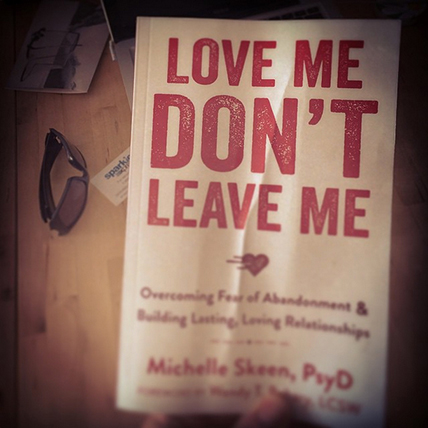
I have received some beautiful emails from readers. I really can’t articulate how much these heartfelt communications mean to me. Knowing that we are not alone in our experiences, our pain and our struggles is such an important part of the healing process and the motivation for change. I am so grateful to each of you who have shared a bit of your life with me whether it be privately or, as with this post, more publicly. Huge heart hugs to all of you.
—Michelle
————————————————————————————————————
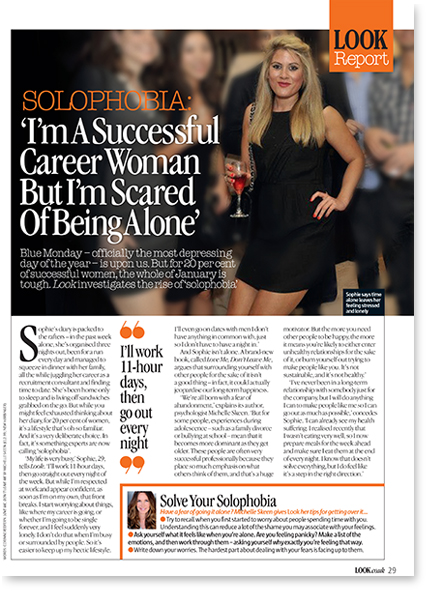
Solophobia
Look magazine UK (print edition)
click to enlarge:
————————————————————————————————————
“5 Fears” in Indonesian!
An Indonesian news site picked up and translated the article, “5 Fears That Can Kill a Relationship.”
Tak Perlu Khawatirkan 5 Hal Ini dalam Hubungan
Adi Waluyo
Metrotvnews.com: Penyebab keretakan hubungan sangat beragam. Tak hanya pertengkaran saja yang membuat hubungan menjadi retak, terkadang pikiran negatif juga bisa menjadi pemicu hingga menyebabkan perpisahan.
“Pikiran bisa menjadi ramalan yang akan terjadi dengan sendirinya,” kata Michelle Skeen, PsyD, penulis dari Love Me, Don’t Leave Me: Overcoming Fear of Abandonment & Building Lasting, Loving Relationships.
“Ketika Anda membiarkan rasa takut dan kekhawatiran keluar dari kontrol, Anda secara teratur menyampaikan pesan tersebut, dan ini bisa menjadi racun bagi hubungan Anda,” tambahnya.
Inilah pikiran-pikiran yang dapat menjadi pemicu keretakan hubungan.
1. “Dia akan meninggalkan saya”
Semakin lama Anda berpikir jika ia akan meninggalkan Anda, akan muncul ketakutan dan ini hanya akan memperburuk hubungan Anda. Pikiran negatif lainnya pun akan muncul seperti khawatir jika ia akan melirik orang lain. Untuk menhindarinya, Anda bisa mengingat masa-masa indah bersama si dia, mengingat hal-hal terbaik yang pernah dilakukan oleh pasangan Anda. ini bisa mneghikangkan pikiran-pikiran negatif dari diri Anda.
2. “Kita terlalu dekat”
Pikiran ini bisa saja muncul saat Anda terlau dekan dengan orang lain selain pasangan Anda. Muncul kekhawatiran jika pasangan tahu sifat asli Anda dan meninggalkan Anda.
“Cara lain untuk melihat ini adalah keyakinan bahwa Anda tidak akan mendapatkan apa yang Anda butuhkan secara emosional dari orang lain. Hal ini bisa dipicu karena Anda terlalu dekat dengan seseorang,” kata Skeen.
3. “Dia curang”
Saat pasangan Anda memberitahu jika ada pekerjaan keluar kota atau pulang terlambat, Anda segera berpikiran yang tidak-tidak dan curiga. Ini tentu saja melelahkan untuk Anda begitu pun untuk pasangan Anda.
“Jika ini adalah pikiran yang sering muncul dengan siapa pun Anda berkencan, bahkan jika mereka telah memberikan alasan untuk percaya bahwa mereka tidak akan mengkhianati Anda, maka Anda mungkin memiliki inti keyakinan tentang ketidakpercayaan,” kata Skeen.
4. “Saya tidak cukup baik untuknya”
Buang jauh-jauh pikirahn yang hanya akan membuat Anda tak pantas untuk pasangan Anda. Pemikiran seperti Anda tak cukup cantik, seksi, pintar atau apa pun itu. Sebab ini hanya akan menyakiti diri Anda sendiri. Manusia tak akan pernah merasa cukup, hanya saja Anda tinggal berusaha untuk menjadi cukup bagi pasangan Anda.
5. “Dia tidak cukup baik untuk saya”
Pasangan Anda tidak bisa melakukan sesuatu dengan benar. Inilah yang membuat Anda berpikir jika dia tak pantas untuk Anda. Namun ini bisa juga dipicu karena ketidakpercayaan Anda pada diri sendiri.
“Ini adalah sabotase pikiran yang sering muncul sebagai ‘pertahanan’ terhadap perasaan atau kegagalan Anda sendiri. Dalam situasi ini, Anda bereaksi dengan menolak sebelum Anda dapat ditolak. Anda pergi sebelum Anda ditinggalkan,” kata Skeen.
Kontrol diri Anda jika memiliki perasaan ini. Ingatlah masa lalu dan jangan langsung bereaksi. Biarkan diri Anda untuk mengontrol pikiran dan perasaan Anda. Setelah emosi Anda mereda, Anda akan tahu jika ini tak ada hubungannya dengan masa lalu. (Ningtriasih / sheknows.com)
Read it on MetroTV News
————————————————————————————————————
New Year, Better Relationships
Austin Woman
Relationship expert Michelle Skeen shares six essential communication skills for healthy relationships from her book, Love Me, Don’t Leave Me: Overcoming Fear of Abandonment and Building Lasting, Loving Relationships.
Self-disclosure. “It’s difficult for us to feel vulnerable. We feel like we won’t get hurt if we don’t let someone know who we really are. Sometimes, though, we expose too much too soon. There are certain people who are not going to be appropriate to share our innermost thoughts with. Go at a good pace. Ultimately, the goal is to make connections by showing parts of yourself that aren’t perfect but make you an imperfectly perfect person, like we all are.”
Listening. “When we feel vulnerable or fearful, often our past experiences come to the surface. We get so overtaken by memories that we’re not listening to what the other person is saying; we’re busy predicting what they’re saying. If you’re overwhelmed emotionally, say, ‘Can we have this conversation another time when I’m not so upset?’ Another strategy is to repeat what you think someone is saying back to them so they have the opportunity to say, ‘Actually, that’s not what I was trying to say.’ We all communicate differently, so clarification is really important.”
Need expression. “The key to need expression is identifying whether a need is a present need or a need from your past that didn’t get met. It can be damaging to put all of your past needs on your current relationships, so it’s important to identify what your present needs are and communicate them clearly. You also can’t have the expectation that one person is going to meet every need. Not that your partner can’t be your best friend, but you have to be careful about how much pressure you put on one person.”
Validation. “Validation helps create a healthy cycle of communication. Whether you agree with someone or not, you can say, ‘Yes, I hear what you’re saying, and I understand why you would be upset about this.’ If the other person feels like you’re hearing them and that you appreciate what they’re sharing with you, they’ll share more, and start to give you the same validation.”
Empathy. “When you’re feeling difficulty making that empathic connection, imagining that other person as a child makes it easier to find an emotional connection that will allow you to at least understand their perspective, even if you don’t agree with it. It’s also a tool I use for people to create self-compassion. We’re our own worst critics; the things we say to ourselves can be so harsh.”
The apology. “To many people, apologizing means that you’re weak. It’s easy to go to a place of judgment because we are certain we wouldn’t have gotten our feelings hurt, but people get hurt by different things. Even if you don’t think that you did anything wrong, you know from what someone is telling you that they’re hurt by something you did. An apology needs to be sincere, and the wording is important. You can’t say, ‘I’m sorry that you think what I did hurt your feelings.’ That’s distancing yourself from the experience. Instead, say, ‘I’m sorry I hurt your feelings. Now that I have this information, I’ll try not to do it again.’ ”
Michelle Skeen’s advice on how to have a better relationship with…
Your spouse/ significant other: “Make a habit of acknowledging every time they do something you like (even if it’s something they do all the time) rather than pointing out the things you don’t like.”
Your children: “Listen and respond without judgment. We want to be there for them, and sometimes we’ll be ready with a solution or impose our views on them rather than listening and understanding.”
Your parents: “Have empathy for your parents. Whatever they did (unless in the case of abuse), have the underlying belief that they did the best they could do with their limited experiences and resources at the time.”
Your boss: “Everyone gets nervous when they have a meeting with their boss. Your mind can race and it’s easy to get defensive. Be relaxed and listen really well to their feedback.”
Your co-workers: “Maintain boundaries. So often, we become friends with the people we work with, but make sure that you don’t mix business talk with pleasure, or mix pleasure talk with business.”
Yourself: “Practice self-compassion. Until we can truly develop compassion for ourselves, our compassion for other people is not as sincere.”
Read it on Austin Woman
————————————————————————————————————
Dating Guru Michelle Skeen Shares Tips for Healthy Relationships at Every Age
The Purple Fig
Last time, TPF had a chance to catch up with relationship therapist Michelle Skeen, who shared her words of advice for healthy and happy dating. Here is part two of our interview with this expert, where she discusses the challenges of dating in one’s thirties and forties, along with unconscious behaviours that can cause a relationship to take a troubled route.
For many single women, especially those who are in their thirties or forties and are looking for long-term relationships, looking for the “perfect guy” is a challenge. In your opinion, what are some tips to learn to accept flaws while dating?
One of the first things that I take the reader through in my book is to understand yourself and get to know what works best for you, and also what doesn’t work. Get to know yourself, as we’re not perfect people. This is a barrier to getting into a relationship. Oftentimes, this is unconscious. It’s important to focus on what’s realistic.
As much as I enjoy watching romantic comedies, that’s a big order on the shopping list! A lot of relationships can develop into that, but it takes a lot of work. Some people think when the right person comes along, no work is needed. I liked that show Married At First Sight, where people were put together based on how they looked on paper. The thing I loved about the show was that there were experts helping them, but even in the best situation, you can’t run away from an imperfect interaction, situation or person.
It’s important to not be rigid and to stay focused on your communication skills. We are all designed to be in love and to be partnered. My purpose of writing this book is to help women overcome these barriers.
What are the unconscious behaviours that can really change the route a relationship is taking, and maybe lead to a break-up or a troubled relationship?
I talked about “testing” earlier, where a lot of the times we test the other person. We want the other person to test us, but we’re not thinking “Oh, I want to test this.” Maybe you start showing parts of yourself that are less attractive, or will show him that you’re not perfect. Maybe you worry that if you’re not perfect, he won’t want to be with you. I think in the early stages of a relationship, you have less of a history and can push that person away. In the middle stages, the other person becomes challenged. “I’ve proven myself to you, why do I need to keep doing this?” There’s this person who is throwing a lot of these uncertain conversations or situations into the relationship. That’s one way it can play out. There’s that self-fulfilling prophecy, and you have proof.
Do women often ignore initial warning signs that a man may not be the “perfect guy” for them? What are these signs?
I added a final chapter to my book that is designed to give strategies and tips to new couples who have just started going out. I think we always want to be done with the dating, and want this guy to be “the guy.” It’s easy to overlook early warning signs, and say “oh maybe he’s having a bad day.” Even though it doesn’t sound romantic, keep a journal and keep track of these behaviours. It’s new, it’s easy to get swept away, and think “oh, he didn’t really do that before.” We can all engage in these behaviours, so it is important to identify if it’s a pattern.
For example, there can be the black and white thinker, who has strong opinions on everything. It’s normal for all of us to have one or two areas that we’re passionate about, but with this person, there’s no grey in his life. That’s someone who you would want to avoid, if it’s a pattern.
The other type is a victim, blames others and does not take any responsibility. Another type is the ex-talker, who can’t stop talking about his ex in a negative way. While it wouldn’t be good if he always spoke of his ex in a positive light, this guy won’t take any shared responsibility. There is also the criticizer, who may not be critical of you right away, but you can anticipate that he may be later.
There is also the idealizer, who puts you on a pedestal and sees you as perfect. The last type is the Don Juan, who is constantly flirting with everyone, whether it’s the waitress, barista or hostess. He is not just focused on you, but also on other women.
This devalues you and you wouldn’t want to be in a relationship with him. It’s easy for us to go to the extremes and reject people, however. That was just a quick chapter at the end, but there’s a section for women who are overcoming certain fears.
What are your best ways for women to stay strong, assertive and open-minded while dating, both before and after they’ve found a great partner?
It’s important to appreciate parts of your life that are working, even without a partner. You might end up meeting someone while doing an activity. Be active, this will make you a happier person, and we’re all attracted to happy people. Get caught doing what you love.
What do you want the other person to see you doing- not staying in your apartment and hiding! Don’t think about it, just do it. Women think too much, and this can be a barrier to action. Pay attention to your behaviours.
For women in their twenties who are trying to figure themselves out, if it starts with only sex, there is already so much pressure on both people. You may attribute nicer qualities to the guy, in order to make it work, or this may lead to you backtracking.
Many relationships which start with just sex never get to the relationship stage, although some do. I love working with younger people, because it is easier to adopt new behaviours. There are no deeply entrenched behaviours, so they are interested in change. However, the dating scene is not just confined to one age group. For women who are older, the change is more dramatic.
Read it on The Purple Fig
————————————————————————————————————
When it’s the Holidays and Your Relationship is on the Rocks
by Lakshmi Gandhi
Metro
For many couples, the next week is often a tense one.
As couples across the country put their last minute touches on their holiday gifts and Christmas trees, the last week of December — in addition to being a week filled with celebrations and friends — can also be one of the most stressful ones of the year.
Unfortunately, it also looks like that stress can eventually lead to a breakup. The online dating site Clover recently looked at data from 150,000 of its users and says the results are startling. The site’s researchers say there is a 300 percent increase in signups during December from people who are currently in relationships.
“I think that there’s something about the holidays,” says psychologist Michelle Skeen, the author of the new book Love Me, Don’t Leave Me. “You get together and give gifts and it gives people pause like, is this really someone I want to buy a gift for?”
However, Skeen also notes that it’s important not to let the busyness and stress of the season to cloud your judgement about the future. We asked Skeen for her tips on how to make the next few days easier on everyone.
Focus on the moment: “We can just ruin a holiday by bringing in our problems from the past,” Skeen explains. “It’s important to focus on the moment and what’s going on right now.”
Don’t let emotions take over: “Not everyone has great feelings around the holidays,” Skeen reminds us. “It’s a time filled with unmet needs and that could make it feel like it’s putting more pressure on you too.”
Be honest: If you and your partner know that things aren’t that great right now, Skeen says that a conversation is in order. “It’s important for the couple to say to each other, ‘We are having some problems right now, but lets just enjoy the season and we’ll either make it or we won’t.’”
Remember that It’s ok to hide for a minute: If friends and family members notice that there is tension between you and your significant other, Skeen notes that it’s not your responsibility to confide in everyone. “There is angst around these gatherings,” she notes. “You can be ready to say ‘Excuse me, I have to go to the restroom.”
Read it on Metro
————————————————————————————————————
6 Steps for Dealing with the Ghosts of Holidays Past
by Michelle Skeen, PsyD, author of Love Me, Don’t Leave Me
eHarmony Advice
The holidays trigger many thoughts and emotions. Hopefully, they are pleasant reminiscences filled with happy feelings. Unfortunately, for some the memories are of experiences that brought disappointment and sadness. Holidays can be a painful reminder of unhappy family times and unmet needs.
Most of us have unpleasant memories from our past. However, having those memories isn’t as problematic as what we do with them. Are you expecting to be disappointed in the present and future because of your past experiences? Are you unconsciously setting traps so that others will fail you because it’s a familiar experience? Or are you isolating or distancing yourself from others with the hope of never feeling disappointment again?
Often, we are unconsciously controlling our current situation and relationships based upon our past experiences and relationships. It makes sense—we are wired to protect ourselves and to predict our present and future based upon our experiences from the past. Unfortunately, this can damage our relationships and prevent us from getting the love that we deserve.
So, how can we deal with past experiences that are negatively impacting our present day situations and relationships?
Here are six steps for dealing with the ghosts of holidays past:
1. Strive for Self-Awareness
Self-awareness is an important first step. Making the connection between your past experiences and your current relationship struggles can seem obvious, but we often fail to make the conscious connection because we don’t want to re-experience the pain. However, the truth is that we are already experiencing pain — and creating more pain — by trying to avoid it.
Instead, by making the direct connection between your past experiences and your current behaviors, you can begin to break the patterns that have kept you stuck, knowingly or unknowingly, in your past. Then, in your mind or on paper, create a snow globe that contains your painful memory—maybe it’s symbolic or maybe it’s an actual scene from your past that is most representative of your current struggles. This helps you contain your memory and enables you to distinguish it from your present day experiences.
2. Recognize When Your Snow Globe is Shaken
Second, when you get triggered by a situation or a memory, imagine that your snow globe is being shaken. The snow swirling around your image represents all of your negative thoughts and painful emotions. Now, take this moment to recognize the connection between your current emotional state and your past experience. It’s normal and understandable that you are still experiencing the pain associated with something that happened a while ago. It’s part of our common human experience. The pain we experience around memories is unavoidable. That might sound hopeless and depressing, but there’s good news, too. The change comes with how you behave in response to these triggering events. When you can begin to recognize that, when you get triggered in the present, you are still reacting to your past experiences, you can begin to make the changes that will get you closer to the healthy and loving relationships that you deserve.
3. Focus on the Moment
Third, focus your attention on the moment. Be present. Bring awareness to your current situation. Recognize that the flood of negative thoughts and painful emotions are tied to your past experiences. Mindfulness is a key component to getting unstuck from your past and making the important distinction between your previous experiences and what is happening now. This means acknowledging your thoughts and emotions (both positive and negative) objectively and with curiosity. View them as a news crawl on the television—they are passing by and you aren’t getting stuck on any specific thought of emotion. Or imagine yourself as the sky and you are watching the weather come and go—the sun, the clouds, the rain, the storms—they all pass and you are just a curious observer.
4. Identify Your Values
Fourth, once you are in the moment and the overwhelming thoughts and emotions have passed, you can make a behavioral choice that will get you closer to the healthy relationships that you desire. This choice can be challenging in that you are likely locked in a pattern of behavior that feels safe. The problem is that this old pattern isn’t getting you closer to the healthy loving relationships that you deserve.
In order to make new – and more helpful – choices, you will need some motivation and guidance when you’re faced with a triggering situation. The key is to let your choice be driven by your values. Thus, you must start by identifying your values, which can often get lost when we are focused on the most efficient way to protect ourselves. One way to reconnect with your values is to imagine what you would want people to say about you at your memorial service. How do you want to be remembered?
5. Make New Choices
Fifth, when you find yourself getting triggered by a person or situation, make the connection to your snow globe and recognize that your negative thoughts and painful emotions are connected to that experience (and others like it) from your past. You should not be reacting today to the person or situation from your past. You need to respond to your present day situation. This means making a helpful behavioral choice that is aligned with your values and with your goal of getting closer to the healthy and loving relationship you deserve.
6. Commit to Compassion
Sixth, bring compassion to yourself and others. We are all on a journey, and we are all touched deeply by pain. Compassion is sensitivity to the suffering of self and others, with a commitment to try to relieve and prevent this pain. Our inner critic can get in the way of accessing our compassionate self. And, if we’ve been hurt deeply we can often view compassion for others as a sign of weakness—making ourselves vulnerable to be hurt again. But, the truth is that our compassionate selves make us strong, and enable us to make meaningful and loving connections with ourselves and others.
The ghosts of holidays past will never disappear, but you can take away their power to control your present day experiences and relationships by staying in the moment and making the helpful behavioral choices that will bring you closer to the love that you deserve.
Read it on eHarmony Advice
————————————————————————————————————
Better Relationships: 10 Fears You Should Overcome
by Arti Patel
The Huffington Post Canada
They say love is all about having the right chemistry with someone, but if you or your partner constantly live in fear, it could cause your relationship to short circuit.
Fears, especially the ones that come up in relationships, can be developed during experiences in our childhood or adolescence, says relationship expert and author of Love Me, Don’t Leave Me, Michelle Skeen. “This creates an internal working model that we use to predict relationships in our adult life.”
Skeen says these fears, which include everything from being judged to being alone, can keep people from building better relationships. If you find yourself falling into one of the categories below, Skeen says you should start by recognizing your fear. If you’re already in a relationship, it’s time to talk about it with your partner.
“Even though these profound fears are from the past, they feel very real in the present when we are in triggering situations,” she says “Intimate relationships are the biggest trigger because we often feel most vulnerable.”
While some fears may be impacting your current relationships, others could you holding back from getting into one. Skeen says if this is the case, you may want to reevaluate your expectations or give someone a chance, for example, before jumping to conclusions about the outcome.
Here are 10 common fears Skeen says people may have before or during relationships.
You Fear Rejection
What you tell yourself: “If I’m not perfect I’ll be rejected…”
If you’re constantly fearing rejection and hide your true self, psychologist and relationship expert Michelle Skeen says this may stop people from getting too close to you or knowing the real you.
You Let Your Emotions Get The Best of You
What you tell yourself: “I’ll never have someone who understands me/connects with me emotionally…”
Skeen says this is when you don’t share your vulnerabilities with others, because you’re worried about how they would respond. “You become angry and demanding when you don’t get what you need,” she says.
You Fear Upsetting Others
What you tell yourself: “If I don’t tolerate criticism or abuse I’ll be alone…”
Not only is this unhealthy way to maintain a relationship, but you may let people take advantage of you. “You are accommodating and compliant as a way to prevent the other person from getting angry,” she says.
You Have A List Of ‘Needs’
What you tell yourself: “ I’ll never get what I need from another person…”
When you have a long list of needs, you avoid relationships because you never feel like you’ll find someone who will fulfill these needs, Skeen says. “You resent others because you aren’t getting the love and understanding that you need.”
You Fear Getting Hurt
What you tell yourself: “People will take advantage of me if I let my guard down…”
Skeen says this is when you avoid getting close to others because you fear they will hurt you in the long run.
You Fear Coming Out Of Your Shell
What you tell yourself: “If people really knew me they would reject me…”
Skeen says some people may hide who they really are — their beliefs, thoughts, dreams — from others because they fear rejection for being themselves. “You may present only a superficial face to the world instead of allowing anyone to dig deeper,” she says.
You Fear Criticism
What you tell yourself: “I’ll never measure up to others…”
“You allow others to criticize you or minimize your accomplishments. Or, you overachieve to avoid criticism of others,” Skeen says.
You Fear Loneliness
What you tell yourself: “I avoid relationships because ultimately I’ll be left alone…”
Some people may focus their time and energy on work and/or extracurricular activities so they keep themselves busy, Skeen says.
You Fear Betrayal
What you tell yourself: “I can’t be vulnerable with another person because they will use it against me…”
If you’re constantly on guard for any sign of betrayal, you may lash out at others as a way to protect yourself, Skeen says.
You Fear Not Having The Perfect Person
What you tell yourself: ”I’ll never get the love I want…”
Sure, some expectations in a relationship are fine, but you should never go into one with a long list of must-haves. If you do, Skeen says this leads people to become angry or frustrated if they find partners who don’t meet their expectations.
Read it on huffingtonpost.ca
————————————————————————————————————
Stop Self-Sabotaging Your Relationships: New Book Claims that We ALL Fear Abandonment and Reveals What We Can Do to Conquer It
by Scarlett Russell
dailymail.co.uk
Childhood trauma, bad break-ups and ‘negative core beliefs’ could be the reason you’re unlucky in love, according to a new book written by clinical psychologist Michelle Skeen, PsyD.
In the book, Love Me, Don’t Leave Me, Skeen describes how a single negative childhood memory or painful break-up in adolescence can lead to deep-rooted feelings of abandonment in later life. And that one single experience could be the one thing that is holding you back from having a loving, lasting relationship.
‘I’ve been working with couples for 12 years and abandonment issues arise again and again,’ Skeen explained to MailOnline. ‘They can surface anywhere from the earliest stages of dating right through to marriage and often go un-resolved. But if we pay attention we start to recognise patterns and themes.
‘We’re all born with the fear of abandonment; if we don’t get looked after, we die. It’s just the degree to which we have it.
The problem isn’t that you’re experiencing the painful emotions or negative thoughts, it’s that you are reacting with unhelpful behaviors.’
Here, Skeen explains some of the ways fear of abandonment may be sabotaging your relationships – and details how you can put a stop to them once and for all.
Trying to Force a Relationship that Isn’t There
‘There is so much uncertainty and ambiguity in dating,’ says Skeen. ‘Safety means predicting, and if we have a fear of being left or rejected, we would rather force an outcome.’
Love Me Don’t Leave Me offers exercises to help you spot the associations you have with these fears, pushing you to think back to times you have felt vulnerable. This enables you to identify all the feelings involved in that experience which will in turn explain your relationship ‘triggers’ – fear that is activated in certain situations.
‘People you meet will have their own set of core beliefs, but they may be less in tune with them and can pull back before the relationship has a chance to grow,’ Skeen adds. ‘Reassuring them will help, but you can only do so much.
‘See the ending of a relationship as a chance for increased awareness about yourself.’
Starting Fights to Push your Partner
‘People do this to test the relationship as their fear of being abandoned means they are expecting to be left anyway, so are almost seeing how far they can push their partner before breaking point,’ says Skeen.
‘Before you know it, you’ve pushed too far and they’ve left, as your expected, but who’s fault is that?’
Skeen suggests creating a ‘Snow Globe’ – focusing on a particularly painful memory and writing down all the details and emotions around it.
‘This makes you more aware of your issue. When it is activated – through an argument or certain behavior it’s shaken like a Snow Globe, but instead of reacting to that fear, you will be able to think and act rationally, communicating your fears.
The Pre-emptive Strike
Have you ever panicked and ended a perfectly good relationship?
‘When we fall for someone it can feel like a loss of control,’ says Skeen. ‘Your reaction may be to strike out altogether, rationalizing that you’re leaving that person before they leave you, even if they have no intention of leaving you. It’s destructive behavior.’
Skeen says you must exercise mindfulness in this situations, rather than automatically ‘freaking out’.
‘It’s the skill of staying in the present and not indulging in your initial, potentially damaging, reaction,’ she adds. ‘You must develop a careful and compassionate response to your current situation. Don’t freak out end it!’
When your issues are triggered, mentally repeat the words, ‘thought’ or ‘emotion.’ This will not only relax you, but make you realize that’s just what these feelings are: thoughts and emotions.
Getting Involved with Someone Unobtainable
Choosing a partner who is married, is known to be a womanizer or who has a demanding job that leaves no room for intimacy are all decisions which stem from fears of abandonment, according to Skeen.
‘If you are convinced no one is good enough, you will choose unsuitable partners who will leave you – as you expect,’ says Skeen. ‘People complain that it’s difficult to meet the right person, but ultimately we have to look at ourselves.’
The book lists common traits found in unsuitable partners, such as being controlling, possessive, flaky or judgmental – and teaches you to focus on values; not specific goals to achieve but the direction you want your life to go in.
‘Use your values to keep you on track, to help you make the proper decision when you’re at that moment of choice when you can choose your unhelpful coping behaviors,’ says Skeen.
Overreacting
‘When we fall for a guy, especially after we’ve slept with them and our hormones are in overdrive, it’s easy to let emotions rather than rationality, take the lead,’ says Skeen. ‘Pushing for that immediate outcome is always going to be really damaging.’
According to the book, the key is to avoiding irrational behavior is to distract yourself. Go for a run or call a friend you know is going through a tough time.
‘Most important is to be comfortable with feeling a little uncomfortable,’ she says. ‘Don’t react to this feeling of unease, just ride it out. Accept that it’s simply an uncomfortable feeling, and that’s all. It doesn’t need attention, or to be fixed.
‘Once you figure that out, the rest just isn’t important.’
Relying on Your Partner for Everything
Being in a relationship means being honest about your wants and needs, says Skeen, but it’s important to have realistic needs based on the present, not the past.
‘We often don’t get our needs met because we’re worried about appearing demanding,’ she explains. ‘But someone with abandonment issues may expect their partner to be all the things they’ve been missing, such as a parent, carer or even previous boyfriend.
‘You’re always going to be disappointed and make the other person feel like they’re a disappointment. You have to make that distinction and let go of that so you don’t overburden the current relationship.’
Read it on dailymail.co.uk
————————————————————————————————————
Relationship Expert Michelle Skeen Talks Mindfulness, Accepting Flaws and Warning Signs While Dating
thepurplefig.com
In her new book Love Me, Don’t Leave Me, therapist and author Michelle Skeen offers tips on mindfulness while dating and learning to accept your partner’s flaws. She also discusses understanding how to take “warning signs” into consideration, when meeting a new potential lover. We had a chance to catch up with this relationship expert, and learned some tips about exploring the always-confusing and eternally intriguing dating scene.
For many single women, especially those who are in their thirties or forties and are looking for long-term relationships, looking for the “perfect guy” is a challenge. In your opinion, what are some tips to learn to accept flaws while dating?
One of the first things that I take the reader through in my book is to understand yourself and get to know what works best for you, and also what doesn’t work. Get to know yourself, as we’re not perfect people. This is a barrier to getting into a relationship. Oftentimes, this is unconscious. It’s important to focus on what’s realistic.
As much as I enjoy watching romantic comedies, that’s a big order on the shopping list! A lot of relationships can develop into that, but it takes a lot of work. Some people think when the right person comes along, no work is needed. I liked that show Married At First Sight, where people were put together based on how they looked on paper. The thing I loved about the show was that there were experts helping them, but even in the best situation, you can’t run away from an imperfect interaction, situation or person.
It’s important to not be rigid and to stay focused on your communication skills. We are all designed to be in love and to be partnered. My purpose of writing this book is to help women overcome these barriers.
What are the unconscious behaviours that can really change the route a relationship is taking, and maybe lead to a break-up or a troubled relationship?
I talked about “testing” earlier, where a lot of the times we test the other person. We want the other person to test us, but we’re not thinking “Oh, I want to test this”. Maybe you start showing parts of yourself that are less attractive, or will show him that you’re not perfect. Maybe you worry that if you’re not perfect, he won’t want to be with you. I think in the early stages of a relationship, you have less of a history and can push that person away. In the middle stages, the other person becomes challenged. “I’ve proven myself to you, why do I need to keep doing this?” There’s this person who is throwing a lot of these uncertain conversations or situations into the relationship. That’s one way it can play out. There’s that self-fulfilling prophecy, and you have proof.
Do women often ignore initial warning signs that a man may not be the “perfect guy” for them? What are these signs?
I added a final chapter to my book that is designed to give strategies and tips to new couples who have just started going out. I think we always want to be done with the dating, and want this guy to be “the guy.” It’s easy to overlook early warning signs, and say “oh maybe he’s having a bad day.” Even though it doesn’t sound romantic, keep a journal and keep track of these behaviours. It’s new, it’s easy to get swept away, and think “oh, he didn’t really do that before.” We can all engage in these behaviours, so it is important to identify if it’s a pattern.
For example, there can be the black and white thinker, who has strong opinions on everything. It’s normal for all of us to have one or two areas that we’re passionate about, but with this person, there’s no grey in his life. That’s someone who you would want to avoid, if it’s a pattern.
The other type is a victim, blames others and does not take any responsibility. Another type is the ex-talker, who can’t stop talking about his ex in a negative way. While it wouldn’t be good if he always spoke of his ex in a positive light, this guy won’t take any shared responsibility. There is also the criticizer, who may not be critical of you right away, but you can anticipate that he may be later.
There is also the idealizer, who puts you on a pedestal and sees you as perfect. The last type is the Don Juan, who is constantly flirting with everyone, whether it’s the waitress, barista or hostess. He is not just focused on you, but also on other women.
This devalues you and you wouldn’t want to be in a relationship with him. It’s easy for us to go to the extremes and reject people, however. That was just a quick chapter at the end, but there’s a section for women who are overcoming certain fears.
What are your best ways for women to stay strong, assertive and open-minded while dating, both before and after they’ve found a great partner?
It’s important to appreciate parts of your life that are working, even without a partner. You might end up meeting someone while doing an activity. Be active, this will make you a happier person, and we’re all attracted to happy people. Get caught doing what you love.
What do you want the other person to see you doing- not staying in your apartment and hiding! Don’t think about it, just do it. Women think too much, and this can be a barrier to action. Pay attention to your behaviours.
For women in their twenties who are trying to figure themselves out, if it starts with only sex, there is already so much pressure on both people. You may attribute nicer qualities to the guy, in order to make it work, or this may lead to you backtracking.
Many relationships which start with just sex never get to the relationship stage, although some do. I love working with younger people, because it is easier to adopt new behaviours. There are no deeply entrenched behaviours, so they are interested in change. However, the dating scene is not just confined to one age group. For women who are older, the change is more dramatic.
Read it on thepurplefig.com
————————————————————————————————————
What Happens When the Chill Girl Falls in Love
Yes, pretending to be a burping, low-maintenance, “one of the guys” hottie will land you a boyfriend. But will it make you lose yourself?
 cosmopolitan.com
by Anna Breslaw
“Being the Cool Girl means I am a…woman who adores football, poker, dirty jokes, and burping, who plays video games, drinks cheap beer, loves threesomes and anal sex, and jams hot dogs and hamburgers into her mouth…while somehow maintaining a size 2, because Cool Girls are, above all, hot. Hot and understanding.…Go ahead, shit on me, I don’t mind, I’m the Cool Girl.”
If you haven’t read or seen Gone Girl, don’t worry—I’m not giving away spoilers; I’m just sharing one of the best passages in the book. Gillian Flynn’s best-selling novel, now a film directed by David Fincher, isn’t just a sharp page-turner. It’s a manifesto about how conforming to the archetype of the Cool Girl (or Chill Girl) is a troubling trend among young women. Being a Chill Girl is all about faking it: Chugging beer when you’d prefer a Riesling, pretending to be into baseball playoffs when you’d rather be watching Real Housewives, disowning conventional girliness in public but drooling over Pinterest braids in private. Alas, playing the Chill Girl is the most effective hack into Dude World short of literally being a human blow job.
Just to be clear, plenty of girls are actually chill. They have tons of dude friends, they’re not invested in the person they’re casually sleeping with, and they like sports and beer. But they’re naturally chill girls, not Chill Girls, who are twisting themselves into repressed, self-loathing woman-pretzels to come off that way. I know this because I spent three years pretending to be one. And once I was actually in a good relationship, my Chill Girl routine almost ruined it.
So, why do twentysomething women fake it? “We have a lot of pressure to be independent, and somewhere down the line, that made us believe that we shouldn’t need ‘traditional’ relationships,” says Emily, 26, a screenwriter in L.A., who was a Chill Girl for six months while dating an unavailable man. “I think I was trying to convince both him and myself that I was sexually and emotionally relaxed enough to have just a fuck buddy.”
Sarah, 27, a comedian, calls it “bro-ing it up. You’re the best of both worlds to a certain type of guy.” Specifically, the kind of guy who pigeonholes women into sexist categories (Chill Girl vs. Needy Girl). “You’re a girl who can hang and also bang…but without the title of girlfriend. It absolves the guy of any obligations. No airport pickups, no meeting parents. It’s like catnip for the man-child.”
Twentysomething girls are particularly prone to the Chill Girl masquerade, says Michelle Skeen, PsyD, therapist and author of Love Me, Don’t Leave Me: Overcoming Fear of Abandonment and Building Lasting, Loving Relationships. By the time you’re in your 30s, you’ve found your identity and developed self-compassion. In your 20s, you’re still trying things on. “When you do play this role and get positive feedback [from men], that feels good for a while,” says Skeen. “It’s not intentionally manipulative—it’s more like a quiet desperation. But it’s not good for women and it’s not good for relationships.”
In the three years I was one and off with my ex—let’s call him Dave—I went from a confident, intelligent person to a fake, crass fembot who ran on $3 PBRs and low self-confidence. I binge-drank, talked shit about other women, and constantly reaffirmed my status as the exception. I’m not like other girls—I can come from anal sex! I drink whiskey straight! I hate shopping! Oral sex and feelings went unreciprocated—because I refused to let on that I wanted either returned. The more I pushed down my own needs, the more reckless my behavior became. As my best friend, Julie, describes it: “We’d get brunch, and you’d be like, ‘I’m fine, this is what I want,’ and it made me want to cry.” How did she know I was lying? I asked. “I’m your best friend, you asshole. Also, you lost a lot of weight and drank too much.”
This is par for the course for Chill Girls, explains Skeen. “Even if you know on some level that he doesn’t really care about you but he likes you in that moment, it’s intoxicating. And then there’s this huge hangover when you realize, He has no idea who I am. I’m not known or understood. That results in a lot of self-destructive behavior, like binge-drinking, eating issues, and shopping addiction, to distract yourself from the fact that none of your needs are being met.” As my drinking and recklessness spiraled, Dave and I split for good. Neither of us could keep denying how bad he was for me—rather, how bad I was for myself around him.
Anna S., 33, a now-married copywriter in New York, became a Chill Girl when an ex-boyfriend requested an open relationship. “I was so far into this I-don’t-care-do-whatever persona that I couldn’t even tell that it was completely destroying me inside. I actually tried to hook him up with a good friend of mine. [The Chill Girl] just totally lets guys off the hook.”
Greg, my now-boyfriend, made it clear from the beginning that my needs wouldn’t scare him away, but even in my new, healthy relationship, I couldn’t relax and be myself.
On our first few dates, in order to show him I’m not one of those Salad Girls, I pounded heavy dinners like Guy Fieri and wound up in pain afterward every time. He eventually had to reassure me that liking kale salad doesn’t indicate that I wear opera gloves when I give a hand job. I pretended I hate-watched Sex and the City, when in truth I love it earnestly to the point of being deranged. When he asked questions like ” Do you want me to spend the night?” or “Do you need me to come over?” I’d want to say yes, but the incessant chant in my head of BE CHILL, BE CHILL YOU CRAZY, NEEDY HAG stopped me. Because I’m not one of those girls. You know, humans.
Once the Chill Girl’s booted up, how do you de-program her? Anna S. broke the habit when she began dating her now-husband. “With my ex, I felt like I wasn’t allowed to want a vanilla, monogamous relationship—but when my husband didn’t judge me for wanting it, I realized that was an okay thing to want.”
Greg was patient with me after I explained that my Chill Girl tics would be hard to shake. (Patience is necessary when you have a girlfriend who says things like “Maybe we should do something for Valentine’s Day, but I mean, never mind, we don’t have to. I’m not one of those girls who’s, like, obsessed with Valentine’s Day.…We could just do something super low-key, like go to a cheap restaurant or roll around in garbage or whatever, haha!”)
His breaking point finally came when I needed an escort home after a minor surgery and he couldn’t make it. I was upset, but Chill Girl texted back: “No worries.” He didn’t buy it. “Just tell me if you’re mad at me,” he said. “This isn’t a battle of who gives less of a shit.” I realized then that Chill Girl actually bored him—he was trying to see past her because he actually liked me. I’d never had that kind of security with a guy before. I no longer needed Chill Girl armor to weather my relationship. It didn’t happen overnight, but after a few months of happiness and stability, I finally shook her off.
Ultimately, you’ll either eventually shed Chill Girl due to sheer exhaustion and lose the guy who fell for her or go in for the long con. And are you really willing to pretend you love degrading porn and beef jerky until death do you part? Just like faking orgasms will sabotage your chances of a real one, faking a personality will only result in a relationship that doesn’t make you happy.
“It’s ironic,” Emily says. “Because I do like comic books and beer. But first and foremost, I’m a woman who knows what she wants and isn’t afraid to admit that that includes some goddamn chivalry.”
This article was originally published as “What Happens When the Chill Girl Falls in Love?” in the November 2014 issue of Cosmopolitan.
Read it on cosmopolitan.com
————————————————————————————————————
Love Me Don’t Leave Me – A Book Review and My “Story” Part One
blogher.com
So. A few months ago, suddenly Susan, I was asked if I would review a book about overcoming childhood abandonment issues to build lasting, loving relationships by Michelle Skeen, PsyD disconcertingly named: “Love Me Don’t Leave Me”. Honestly, I do understand the value of a catchy title but this one had me picturing myself blurting out those words as my first date got up to go to the washroom. Never to return. I’ve not yet had the urge but then I’ve only been online for a couple of years. ONLY. Check back with me in another chunk of time if I’m still single and dates are thin on the ground, I’m just saying. ThinnER.
But. Let me reassure you, when I actually read the book, I found it to be insightful and thought provoking. Michelle basically posits that many of us are affected by toxic childhood schemas or core beliefs ie “frameworks that help organize and make sense of information and the things around us.” Because they’re by nature definitive, “black or white/ negative or positive and serve as a predictor even in the absence of all the information”, when negative schemas get activated, we go into protective fight, flight or freeze mode. ( Fyi, I’m a freezer. Big time. Curses. ) Then something termed “the amygdala hijack” happens. Love that term btw, coined by Daniel Goleman in his book Emotional Intelligence ( 2006 ) However, I don’t love what it means: “when we experience powerful emotions like fear it overwhelms our rational thoughts and this can lead to behavior that is harmful to us rather than helpful.” #ThatsNeverGood
The primary maladaptive core belief covered in this book is of course abandonment with four other basic, closely correlated schemas: mistrust and abuse, emotional deprivation, defectiveness and failure. All of these come from Jeffrey Young PhD’s concept of early maladaptive schemas/ EMS. Fascinating. It’s like an emotional train wreck you can’t stop looking at because hello…you’re in there somewhere. I found myself snug within emotional deprivation myself with a lifelong pass to defectiveness and failure in the adjoining cars. AMAZING!
There’s questionnaires you go through to number your experiences from “1 to fuck, that’s so me” and while my numbers were low, I recognized key statements as being deep within my own psyche and definitely from my own childhood. Not that they were news, mind you. I’ve known this shit for DECADES. Known that they’re embedded remnants of growing up emotionally neglected and always feeling less than, never feeling loved and lovable just because. Always striving to earn love because I figured out at a very young age it wasn’t just lying around for free, dude! Not in my Asian household. And taking on blame for anything and everything because being unlovable was obviously my own fault, wasn’t it? I mean, as a kid I was sooo eager to please, just dying for some attention…PLEASE! And yeah no. Not so much.
How has this affected my connections with the people in my life right now? Well, to be honest, I became estranged from most of my family when I split from my ex husband but I have excellent relationships with my son and my friends. It’s probably the decades of working on letting go of the past and choosing who I want to be, regardless of the baggage I grew up with, and of course wanting to be the exact opposite of the mother I had. But the relationship I have with myself and how that’s been played out on the dating field? THAT’S a lot more conflicted. My daily challenge is to be as kind and loving to me as I am to everyone else in my life. Daily. CHALLENGE.
We ALL have stuff. Obviously. And was I that dying to please/ do anything for your approval/ yes, I’ll take blame for $1000, Alex! adult for many many years? HELLO. Am I still?? Less. But. I’m not going to lie; it’s a going concern. It’s also life. We all have our stuff.
However, as Michelle says and which totally resonated with me: we also all have a story but we don’t have to BE our story. In other words:
“You can’t change your core beliefs, you can’t really change what triggers your core beliefs and you can’t change the feelings that surface. But you CAN change your behavioural reactions.”
Here’s how I used to manifest my story/ who I was when I was with my ex husband from the tender and achingly naïve age of 24 until the “I’m ready to be my own person now, fuck the consequences” departure age of 42:
We got engaged a year and a half after dating/ living together and the next morning in the shower, I started sobbing. SOBBING. I never thought anyone would love me enough to marry me. Literally. When I was little, I would dream of having three children but I could never imagine getting married. I thought I would die of cancer before this would ever happen – I guess so I wouldn’t have to live my entire life knowing I wasn’t loveable enough to be with until death do part. How. Fucked. Was. That. Emotionally deprived/ defectiveness/ failure schemas much?
So. After you identify what you feel are the core beliefs that are holding you back, the book goes on to give you practical tools to understand and work with what you’ve been given. For example, Michelle describes “creative hopelessness ie accepting unavoidable pain” and says while the primary pain of the human condition is “unavoidable and uncontrollable”, “we have the power to eliminate the secondary pain we create to try and avoid or control our primary pain.” Which, as I repeat, is UNAVOIDABLE AND UNCONTROLLABLE. This is good news, people! If you accept this and accept that you CAN change your behavior in reaction, it’s a start! That and imagining that “you are the sky and not the weather” – letting negative thoughts pass through you like clouds pass by overhead. Honestly? I love that analogy. It makes sense to me. It helps me.
Obviously, I recommend “Love Me Don’t Leave Me”, questionable title and all. It’s for anyone who feels like they’ve been a little or a lot fucked over by their dysfunctional childhoods so yeah…pretty much everyone. It’s not about assigning blame but looking at the situation with new eyes and new concepts of why you’re fucked up and tools about how to not be AS fucked up. #Ftw.
At the end of the forward, Michelle says:
“I wear a bracelet that reads ‘it matters not what road you take but what you become on the journey’.”
As Lucy, I’m all about who I’m becoming on my path of discovery and self-empowerment so yeah…Michelle is obviously one of my tribe and her book is totally worth the read and the work it entails thereof because YOU’RE totally worth it. Amiright?
Ps I knew when I finally got around to writing this post after cogitating on it for many weeks that it would probably be a two parter. I’ve been really letting it soak in and connect with my own issues to see what came up/ what I would eventually write. It may appear I choose my topics but I’m just a channel really – I sit down with an idea and words come out. This is what came out: Life in general is part one; dating in particular is part two.
Stay tuned. The damage control continues. HA!
Read it on blogher.com
————————————————————————————————————
Love Me Don’t Leave Me Part Two – The Dating Years
blogher.com
In part one of Love Me Don’t Leave Me, I write about how close to the bone several of the toxic childhood schemas were for me and the general effect of issues thereof for many years. I mention my current strong, healthy relationships – thank God – and how I got married as one person and got divorced as another when I’d salvaged enough of my true self from my primary pain. What I didn’t delve into was how, until recently, I feel “my story” was a third wheel on most of my dates. #Goodfuckingtimes.
To begin, it’s incredible to me how I’ve changed since I went back on POF the second time as a born again virgin. Certainly, I’d advanced greatly since the first time when I was on for six weeks which felt like six MONTHS and I was so scarred from the experience I vowed: “Never again!” Well, never came sooner than expected as it often does.
Was I actually ready to date online? Don’t be ridiculous. That’s like asking: Were you ready to be a mother? Of course you say “yes!” Then you spend the rest of eternity dating/ mothering and asking yourself: “Was I on CRACK COCAINE??” But I’d been so lonely I was at least ready to try. And try. And try again. I’ve been on a hella lot of first dates, kids. Just saying.
When I began treading water once more in the POF pool, I was my usual take everything personally/ serious as a heart attack self. Therefore, every message that went nowhere, every interaction that disappointed was an opportunity for me to ask: “what’s WRONG with me??” always seeing the inbox as half full. I had no idea how to be easy going or take things lightly – LIGHTLY?? Get a grip, man! Life is hard and then you die. Probably on a horrible first date. Get with the program.
Also, I’ve never been a natural with the opposite sex, to be honest. I’ve always felt awkward, with low self esteem and little confidence in my attractiveness or personality. Growing up, I was never told I was pretty or smart or a good person; I never felt valued for any reason. I only got attention when I got in trouble, which wasn’t very often because I was always trying to be sooo good…to get some fucking attention!
This is why my “emotional deprivation” score in Love Me Don’t Leave Me, though only “fairly low”, was my highest of all the questionnaires in the book. “If you grew up in an environment where you didn’t receive emotional support, attention, affection, guidance and understanding, then emotional deprivation is probably one of your core beliefs.” I highlighted “your feelings or experiences weren’t valued or validated.” No shit, Sherlock. Add a big scoop of “defectiveness” and a healthy pinch of “failure” and there’s my flavor profile growing up.
My parents were negative people and early on, I internalized all of that negativity as guilt and blame, taking responsibility for things I had no control over yet I still managed to feel Iike I had a big L on my forehead. When you combine a sensitive kid with highly insensitive, emotionally unavailable parents, you get a version of me – I’ve always been able to give love easily but I was given very little practice receiving it, therefore I never felt I deserved it. Fast forward, put all of that in a cute dress and out in the big bad world online to find a new mate at 50 years old…hahaha…YEAH, right?
It’s been over two years now on this journey learning about myself and finally I can look back and see a pattern and feel how intensely my core beliefs were manifesting as knee jerk reactions to commonplace events. Hello, amygdala hijack! As a big example, whenever it took longer than I thought it should ie immediately to hear back from someone via email or text, I’d immediately assume something was wrong and blame myself. I said something wrong. I did something wrong. OMG. I knew I shouldn’t have said/ done that! WHY did I say/ do that?? Even if it was the most innocuous of communications, I felt like I was on a tightrope of human etiquette. Blindfolded. The highs were very high when an interaction went well but the lows were sooo low because everything felt so random. I was so random. And as much as I tried to be open to love, in hindsight I see that I still felt unlovable to myself – always not good enough. Jesus. The “unavoidable and uncontrollable primary pain”. Brutal.
But. As Michelle says and I finally began figuring out, I am NOT my story. My parents did what they could and I stopped blaming them years ago; however, I’m trying my damnedest to stop blaming MYSELF now and holy shit – is THAT a lot nicer place to live from let alone date!
How did I get here from there, you ask? Really, it’s been hard core hands on trial and error. It took a good while before it became self-evident that while the guys would come and the guys would go, it was still me in the mirror every day and I just wanted to be happy. Comprehending that my life was about me was gradual and then it was like a thunderbolt. MY LIFE IS ABOUT ME. Did I want to spend it treating myself like shit while I treated everyone else I loved like gold? Really?
I understood how much I’d changed when I went on a potential fwb meet a few months ago which was the oddest non-date date I’d ever been on. Seriously. We were like seatmates on a plane for three hours. About thirty minutes into this weirdness I thought: “Wow. This reaallly isn’t going well, is it?” But I thought it with complete detachment and I made no heroic leap to try and save it or take responsibility for it. At. All. In fact, I sat back and waited for him to make an effort and when it was not forthcoming I went: Huh. And then just let it all happen.
That moment was revelatory to me. COMPLETELY. I was no longer trying to please my date as my date had no interest in pleasing me. The date was DIVE BOMBING…and I didn’t take ANY OF IT personally. At all. It was fan. fucking. tastic! Take THAT, you fucking failure core belief, you!
In fact, doing a stint on a fwb site after spending six months with Mr. Sooo Sexy and Sooo Damaged was just what the doctor ordered and no, I don’t mean the 21 year old with the 10 minute turn around though that WAS fun. It was just me finally taking things as easily as an afterthought. Messages came and went. Guys came and went. Sometimes I was a little bit sad or disappointed that someone didn’t work out but then I just let it go and moved on. If I didn’t hear back from someone, I no longer castigated myself. The sheer luxury of not rearranging everything negatively then putting it all on my shoulders was unparalleled. I actually FORGOT some guys because…well…they weren’t very memorable, obviously. That was unheard of before! I usually have the memory of an elephant…and usually only for the bad shit.
Maybe it’s Alzheimer’s? But hopefully, it’s just me being happy no matter how the dating goes or doesn’t.
Hopefully, it’s just me being the sky and not the weather. Hopefully, it’s just me becoming ME. Story not required.
Did I have Love Me Don’t Leave Me at the beginning of my dating journey? Nope. Would it have helped? Yup. Often, just trying to identify and articulate the root of your pain is overwhelming and will stop you in your exhausted tracks. I found this book to be clear and accessible, both in language and in practical tools, and at times actually conducive to personal epiphanies. Ftw.
Make no mistake – you will still have to do all the work and it’s no fucking picnic in the park but again, it’s your life. Not what your parents made it. Not what a random date can more than momentarily affect. YOURS. If you’re not all: “My life fucking ROCKS!! I fucking rock!!” then maybe it would benefit you to bone up on maladaptive schemas, amygdala hijacking and the difference between primary and secondary pain and by maybe I mean yes, completely.
Then none of us will have to yell: LOVE ME DON’T LEAVE ME! at anyone. That would be a good thing, amiright?
Read it on blogher.com
————————————————————————————————————
5 Fears That Can Hurt Your Marriage
thestir.cafemom.com
by Adriana Velez
There’s something scary a lot of women do, whether we’re in a new relationship or we’ve been married for years:
We imagine how it will all end. Maybe it’s how he’ll die tragically in an accident, or maybe he’s going to cheat on you, you’re sure of it. But we carry around these fears and we let them torture us.
Can you relate? Do you do that, too?
Going there every once in a while isn’t such a big deal. Everyone does it. But for some of us, these dark fantasies become obsessions, and they can lead us to some irrational, undermining actions. Our fears can end up ruining our relationships.
There are five main fears women have that tend to undermine their relationships, says psychologist Michelle Skeen, author of Love Me Don’t Leave Me: Overcoming Fear of Abandonment & Building Lasting, Loving Relationships. And just as you’d expect, these anxieties usually come straight from our childhood and other past experiences.
Recognizing your fears, Skeen says, is the key to building the healthy, loving relationships you need.
1. Fear of abandonment: This is the biggie, Skeen says. Women with this fear tend to think, People who love me will leave me or die, or No one has ever been there for me. They’re unpredictable and in the end I will be alone.
This worry can come from a single experience or from people repeatedly moving in and out of your life. “Those experiences,” Skeen says, “can make you feel like people aren’t always going to be there. And they can get triggered by something as simple as someone not getting back to a text message quickly enough for you.”
2. Fear of abuse: People with this fear tend to think, “I always get hurt by people close to me,” Skeen says, or “People will take advantage of me if I don’t protect myself.” Unfortunately, she adds, “Sometimes a woman’s fear of abandonment will make them tolerate abuse in order to keep their partner from leaving them.”
3. Fear of not getting your emotional needs met: This is a feeling of loneliness, Skeen says. “It’s about not getting anyone in your life who loves you and not feeling emotionally connected to anyone.” Women with this fear tell themselves, People close to me won’t take the time to understand my emotions.
4. Fear of your flaws: If people really knew me, they’d reject me, says the voice inside your head. “As you get closer to someone and develop a relationship, you may worry about being seen as a whole person with flaws,” Skeen says. “Then you worry that when your partner sees who you really are, he’ll leave. You feel ashamed of your faults and try to present a false self.”
5. Fear of failure: “This is not feeling as successful as your peers, not feeling as smart, not feeling like you measure up,” Skeen says. You’ve failed at everything else. Why shouldn’t you expect your relationship to fail as well?
Here’s the good news: You don’t have to try to repress these fears. “Our minds are like a popcorn machine with thoughts popping up all the time,” Skeen says. “We can’t change our thoughts, but we can accept them without judging ourselves for having them. Stay in the present and stop trying to predict the future according to the past.”
And while you can’t control your feelings or the people in your life, “you can control how you respond to them,” Skeen adds. That’s how you keep your fears from completely destroying perfectly good relationships.
Do any of these sound familiar? What relationship fears do you have?
Read it on thestir.cafemom.com
————————————————————————————————————
Tired of relationships bringing out your “crazy?” Maybe this will help.
girlgetyourrootsdone.com
by Amanda McPherson
Do you panic when he doesn’t text you right back?
Have you been called clingy or even crazy by a partner?
Do you bolt from relationships at the first sign of trouble?
Any of these experiences sound familiar? Yeah, me neither. Never. That stuff is for crazy chicks…
OK, fine. Maybe once, just once, I sent a strongly worded text when he didn’t respond in the timeframe I expected. Oh, and there was that time he didn’t call back when he said he would… Yeah, I guess I kind of panicked a little…
What if I told you that we aren’t “crazy?” Our intense feeling of fear and panic is understandable, more common than we think, and it has a name…it’s called Fear of Abandonment. And, as a member of the human species, there is a good chance we have or will experience it.
Being abandoned, hurt or disappointed by a another person can be a painful ordeal that leaves a scar on our minds and hearts. And sadly, unless we live in a bubble, it’s pretty impossible to escape the experience of feeling abandoned – physically and/or emotionally – by someone we love. It’s natural and understandable that we would try our darndest to avoid having to feel that pain again. But, ironically, our hypervigilance to never feel this pain again could be preventing us from being in the kind of intimate relationships we crave so deeply.
Luckily, the book, Love Me Don’t Leave Me – Overcoming Fear of Abandonment and Building Lasting, Loving Relationships, by Dr. Michelle Skeen, is a great resource in helping women understand how our fear of abandonment is impacting our relationships. I had the honor of interviewing Dr. Skeen about her book and was struck by her openness, honesty and compassion. Reading her book feels like you are talking to a trusted friend. She humanizes the experience and helps us to understand that we are not alone in this struggle.
Her approach is refreshing in that she doesn’t try to tell us how irrational we are to have these fears and messy reactions. I mean, we all know better than to freak out, right? But, when the fear of abandonment comes over us, it can feel virtually impossible not to react. Dr. Skeen is honest about the fact that we will likely always have to battle the fear of abandonment to some degree. However, her book offers an incredible arsenal of tools to help us engage in the war on fear.
Love Me, Don’t Leave Me cuts to the core of what many of us dread so deeply – the fear of being abandoned by someone we love. Dr. Skeen encourages us to explore our values and how they inform the choices we make in who we date and how we communicate in our relationships; all-the-while building awareness around where our fear of abandonment is coming from so that we can begin to face it head-on.
This book will give you the tools to be your healthiest self in a relationship – even when your fears are triggered. Love Me, Don’t Leave Me will also help you identify the types of people who trigger your fear, and will teach you useful techniques that will help you respond to your fear in a way that won’t make you sound (and feel) like a clingy or controlling you-know-what. I sure wish I had read this book when I was in my 20s!
Girl, of course you aren’t crazy. But, when the fear of abandonment kicks in, it sure can feel like you are! Do yourself a favor and grab a copy of Love Me, Don’t Leave Me. Your fears don’t have to continue to sabotage your relationships. Love can win.
Read it on girlgetyourrootsdone.com
————————————————————————————————————
Stop what you’re doing! How to change behaviors that hurt your romantic relationships
eharmony.com
by Michelle Skeen, PsyD
We all strive for close, loving, lasting relationships – but for many people, fear gets in the way. Depending on what you’ve experienced in the past, you may fear that the person you love will leave, or cheat, or treat you badly. And these fears can cause you to react in ways that push your partner away, rather than drawing him closer.
Do you feel like you have to be perfect or you will be rejected? Do you become clingy or demanding when you feel someone pulling away? Do you panic when you don’t receive an immediate response to a text, email, or voicemail? Do you try to avoid your fears by numbing out with food or a few cocktails?
When deeply rooted fears surface, you may be so overwhelmed with anxiety, panic, and sadness that you react quickly in an effort to avoid the pain, or prevent the loss of connection. This is a natural and hardwired reaction. Unfortunately, these attempts to avoid painful feelings and experiences likely make your situation worse in the long term, despite feeling somewhat successful in the short term.
The truth is that, while the pain will never go away, you can learn to avoid the suffering that comes with it. The key is becoming aware of how you’re reacting when you experience painful emotions and negative thoughts, and finding new ways to manage the pain using healthy behaviors that will distract you from engaging in unhelpful reactions to the triggering event.
So what qualifies as a distracting activity? Any healthy pursuit that will divert you from acting on the difficult emotions that you are experiencing.
Doing something else—instead of resorting to the destructive strategies you’ve turned to in the past—provides a window of time during which the intensity of the emotion is allowed to decrease. It will be easier to make helpful choices when your negative feelings are more manageable and you have some distance from them.
Distracting activities are not about trying to avoid or escape your emotions; they are about giving you some space so you can see more clearly. Here are some suggestions for activities that you can use to distract yourself from engaging in unhealthy and unhelpful coping behaviors when you are flooded with negative emotions.
Exercising: Any form of exercise is going to be helpful. Exercise releases endorphins—a natural pain reliever and antidepressant that elevates mood and contributes to your overall well-being— which decreases levels of cortisol (the hormone related to stress) and increases and maintains feelings of self-esteem. Additionally, exercise increases blood and oxygen flow to the brain and increases chemicals (dopamine, glutamate, norepinephrine, and serotonin) that help with cognition. In other words, you’re not only distracting yourself from unhealthy and unhelpful behaviors, you’re engaging in a behavior that has positive psychological and physical benefits. Exercise options are as diverse as jumping rope, Pilates, rollerblading, weight lifting, hiking, running and biking.
Hobbies and Special Interests: If there is something you have always wanted to do, or do more of, identify that activity now. This could be drawing, knitting, photography, walking your dog, watching movies – the list is endless.
Volunteering: When your fears get triggered and you are flooded with negative emotions it becomes all about you and your experiences. In fact, the feeling of “it’s all about me” is part of the problem, which is why focusing on someone else is an especially effective distraction. There are few activities that are as rewarding and make you step outside of yourself as much as doing something for someone else. This might involve going to a soup kitchen and serving meals to homeless people, or it could be as simple as offering to walk your elderly neighbor’s dog.
To-Do Tasks: Another great way to distract yourself is to tackle some of the projects on your to-do list. Your list may include everyday housekeeping chores, organizational tasks, or personal projects.
Relaxation and Self-Care: You can also distract yourself by engaging in relaxing activities, such as getting a mani/pedi, listening to music, or taking a bath.
Now it’s time to create your personal distraction plan. Think about what kinds of events or interactions trigger your fears and anxieties. Use a 3×5 card, sticky note, or your smartphone and list some distracting activities for the situations you identified. Keep in mind that your favorite activity may not always be appropriate when you need it (e.g., although you may love running, you probably go for a run if you’re in the middle of your workday when you need a distracting activity), so include activities that are suitable for different situations and circumstances. Also list some distractions you can rely on no matter where you are or what the situation. Keep the card or sticky note in your wallet or on your smartphone.
Now you are armed with a distraction plan that will stop you from reverting to the unhelpful behaviors you have relied on in the past – and help you on your road to happier, healthier, lasting relationships!
Read it on eharmony.com
————————————————————————————————————
Psychologist breaks down relationship fears in new book, ‘Love Me, Don’t Leave Me’
cupidspulse.com
Interview by Whitney Johnson. Written by Sarah Batcheller.
It’s safe to say that psychologist and author Michelle Skeen is an expert when it comes to addressing fears. In her new book, Love Me, Don’t Leave Me: Overcoming Fear of Abandonment and Building Lasting, Loving Relationships, she provides readers with powerful, enticing tools to handle a multitude of relationship fears, specifically that of abandonment, and details the ways in which these fears stem from early experiences. Thought-provoking and inspiring, Skeen encourages readers to realize what’s holding them back in order to reach their full potential as a partner.
Why did you focus on the fear of abandonment?
I chose to focus on the fear of abandonment because it’s a primary fear that affects a lot of relationships. I think it exists in multiple scenarios: women stay in relationships that aren’t healthy for them because they’re afraid of being alone, they avoid getting into relationships because they fear being abandoned, or they behave in ways that cause them to be abandoned.
Do you think that every individual carries a little bit of this fear with them in some way?
Absolutely — we’re born with it! If we’re abandoned when we’re babies, we die. I think it’s hardwired in us, and I think that it can get reinforced with early childhood or adolescent experiences or trauma, like the death of a parent, a traumatic divorce, or the death of a sibling or a friend. I think that the groundwork is laid in the beginning of our lives for our fear to either be increased or maintained at a lower level. One of the primary purposes of the book is to develop the awareness of what’s going on. With awareness you can make change, so it’s about identifying the problem.
You know, we all have a story, and most of the time, when people are having difficulties in relationships, it’s related to them being stuck in their story, their story being their past experiences. If they’re not in the moment and evaluating their present experience based on what’s going on in the now, they are making predictions based on their story. So part of it is identifying your story and then distancing yourself from it.
How should someone react if their partner begins to push them away out of fear?
Well, I think that a lot of times what’s happening when we push people away is that we’ve already predicted what’s going to happen, so we’re taking control of it. We’re having a difficult time dealing with the uncertainty and ambiguity of whatever is going on in the relationship at the time, so rather than sitting with that and feeling really uncomfortable, we would rather take control and reject it before we can be rejected.
As a partner, if you have the ability to identify the reasoning behind your significant other’s behavior – for example, “You’re doing this because you’re afraid that I’m going to do it to you” — then I would suggest you make the effort to move toward the person. Try to bring them into the present moment, what is truly happening between the two people and not the memory of something that’s happened before that’s getting in the way.
Something we all need to work on is mindfulness. Mindfulness is such a game changer. It allows us to recognize, “I’m having these painful thoughts and emotions, and I need to get rid of them because this feels horrible.”
How can our readers work on mindfulness?
Well, there are so many great mindfulness resources. What I found is a lot of people are intimidated by the idea of mindfulness. They think they need to sit with their legs crossed and keep their mind completely clear. That’s not what you need to do at all.
Mindfulness is about recognizing that every experience, thought, and emotion you’re having is a temporary state. It’s going to pass through you. You just need to be and think, “Oh, I’m having this thought that I’m going to be left, and I’m letting that go.” You’ve got to accept all of your thoughts, whether they’re helpful or unhelpful. There are a lot of great mindfulness exercises which I introduce in my book, like a mindful walk or adding this mindfulness piece to your morning cup of coffee or tea.
What are some long-lasting skills and insights that people are left with once they discover and address their fear?
Well, I think it’s important to identify the behavior that isn’t working. Behavior is one thing we do have control over. In a world where we’re constantly looking for control, we can’t really control our thoughts or minds; they just happen. We can control our behavior. We can’t control anyone else’s behavior, but if you’re engaged in helpful behavior, it will result in the other person adjusting their behavior.
So I think identifying unhelpful behavior, recognizing what situations trigger these thoughts of abandonment and fear, and looking at your typical reaction to that fear is where you have to start. Then, you have to stop reacting that way and look at ways that will be helpful in getting you closer to what you want.
Read it on cupidspulse.com
————————————————————————————————————
Listening your way to a healthy relationship
loveengineer.com
by Michelle Skeen, PsyD
Listening skills are an essential part of healthy communication and are necessary components for building lasting relationships. Truly feeling heard is a powerful experience. It makes you feel cared for, validated, and important. We are faced with so many distractions in our lives that when someone sits down and really listens, it can make you feel really connected. And if you feel like you are sharing an important part of yourself, you want to know that the other person is listening.
Unfortunately, knowing the importance of listening doesn’t obliterate the barriers that get in the way of active listening. We can have the best of intentions when we are engaged in conversation, but we are constantly—consciously or unconsciously—fighting barriers to listening.
For example, we’ve all been guilty of pseudo-listening, or half-listening. It happens with my daughter, Kelly, and me, and we know when the other person is doing it. Our exchange goes something like this: When I’m midstory and I’ve just said something that she would normally respond to, but doesn’t, I know that I don’t have her full attention. So I say, “Kelly, are you listening to me?” She responds, “Yes, I heard every word you said,” and then she repeats every word that she heard me say. But it’s clear that she hasn’t processed the content of my words; she heard them but she can’t give me any meaningful feedback without thinking about it longer or having me repeat what I said.
Start noticing when you are listening and when you are pseudo-listening. Many things can get in the way of your ability to stay focused on what the other person is trying to communicate to you. Most of us have been in an icebreaker situation where everyone is required to stand up and say a little bit about him-or herself. At the last event that I attended we were asked to complete this sentence: “If you really knew me.…” After hearing this announcement, every person in the room was only partially engaged in the listening process. Our individual attentions were primarily focused on rehearsing (in our heads) what each of us was going to say about ourselves (which might change after hearing what the people who spoke before us said), judging what the other participants were saying (along with additional judgment, such as “Did he get dressed in the dark?”), comparing ourselves to others (“She’s so clever!”), or thinking about our plans for the evening (“I am going to need a big cocktail when this is over!”). We’ve all done it. And the blocks to listening get worse when we are having a conversation or in a situation that makes us especially anxious or uncomfortable – such as dating or a romantic relationship where our fear of being left can get triggered.
We all use listening blocks—knowingly or unknowingly. It’s a bad habit and a roadblock to establishing healthy communication and building meaningful relationships. Becoming aware of these listening blocks will get you one step closer to healthy communication and developing active listening skills.
When you are an active listener, you are not only tuned in to what the other person is saying, but you are responding with words, body language, and eye contact that indicate that you are listening. The other person knows that you are paying attention because you will be asking questions and givingfeedback without judgment.
Here are three steps you can take to become an active listener:
Step 1: Paraphrasing
Paraphrasing is using your own words to state what the other person has said. It is important that you paraphrase every time you are having a conversation about something that bringing up fear and anxiety, because doing so will stop miscommunication in the moment. False assumptions (such as: “He says he was working late last night; I bet he was hooking up with someone else”) will be eliminated instantly. Also, paraphrasing is a useful tool for remembering conversations afterward. This makes for clean communication that eliminates misunderstandings.
Step 2: Clarifying
Clarifying is an extension of paraphrasing. It involves asking questions until you have a clear understanding of what is being communicated to you. This step allows you to get more information to fill in the details of what is being communicated to you. It also sends the message that you are actively engaged in the communication process.
Step 3: Feedback
The final step is to take the information that you’ve acquired from your conversation and talk about your reaction in a nonjudgmental way. This is called feedback. It’s an opportunity to share your thoughts and feelings. Your experience might be that you understood the message that was communicated to you but you are unclear about how the person is feeling. You could say, “I understand what you’re thinking, but I’m not sure I understand how you’re feeling about it.”
Giving feedback is helpful to the other person too because he can better understand the effectiveness of his communication and quickly correct any misperceptions or miscommunications. There are three important rules for giving feedback: It must be (1) immediate, (2) honest (this isn’t a license to be hurtful), and (3) supportive.
Ultimately, active listening will eliminate many of the barriers that have prevented you from hearing what is being said in the present moment. It is a skill that will help you avoid getting trapped in the same vicious cycle – whether it’s mistrust, feeling misunderstood or unappreciated, or the fear of being abandoned.
Read it on loveengineer.com
————————————————————————————————————
Tempted to cheat? Here’s how to save your relationship
chatelaine.com
by Flannery Dean
More and more women are choosing to stray — but why? Flannery Dean looks at the real reason people cheat and how to avoid it.
It seems women are having affairs more than ever before and they’re doing so in numbers comparable to men. In Canada, 10 percent of women admitted cheating on their long-term partner (14 percent of men made the same admission). And in the U.S., 19.2 percent of women and 23.3 percent of men admitted to adultery, according to a poll by the Kinsey Institute.
But it may not be that more women are cheating necessarily. It may simply be that they’re more comfortable admitting it now, says Kelly McDonnell-Arnold, a sex therapist based in Waterloo, ON. New admissions aside, however, there are factors that could account for the infidelity bump among women.
Opportunity has increased for one, says California-based psychologist and relationship therapist Michelle Skeen, the author of Love Me, Don’t Leave Me. In the age of social media, reconnecting with former flames has its temptations. “I’ve heard so many people [go] on Facebook and they get curious about what happened to their high school boyfriend…especially when there is a problem in [their] relationship, ” says Skeen.
But what makes someone cheat? Contrary to popular ideas surrounding the subject of infidelity — men cheat for sex; women cheat for love — Skeen doesn’t believe that men and women cheat for different reasons. “I think in some ways it all boils down to a need for attention and validation for both genders. Maybe that manifests a little bit differently. But I don’t believe that men have higher sex drives than women,” she explains. That need to feel special, while natural, can become even greater during periods of stress and upheaval. And relationships go through many stresses and transitions. Big life changes can be risk factors for infidelity in the sense that they can cause conflict and negatively affect communication in a relationship, which can result in feelings of loneliness and isolation as well as low libido.
The Kinsey poll found that the most commonly cited reason for cheating was unhappiness with the relationship. “Affairs are distractions from looking at ourselves; distractions from having to have difficult conversations,” says Skeen.
The strategy: make open, calm communication the priority. The first difficult conversation you need to have is with yourself, says Skeen. “Before you have a conversation with your partner about how you’re feeling, really figure out how you’re feeling. Where is that coming from?”
Next, fill your partner in on how you’re feeling and establish proper expectations moving forward. “Are you asking for too much from one person?” asks Skeen. If so, consider how you can take responsibility for your own happiness.
Conjure your inner single gal, and do something to make yourself happy. McDonnell-Arnold advises not to put so much pressure on your partner to give you what you need. “If you’re feeling bored, go on a girls trip. Be responsible for your own happiness.” When you’re happier, you’re more able to deal with relationship challenges calmly.
And in dark moments, focus on the endgame. “[You] go through natural changes and you may not be changing at the same time as your partner and a lot of times that will cause a divide,” says Skeen. “Are you going to work on coming back together or are you going to go for the quick medicine?”
Read it on chatelaine.com
————————————————————————————————————
5 Fears that can kill a relationship
sheknows.com
by Jamie Beckman
Are you letting one of these things ruin your relationship?
Relationship worries, like the five below, are often symptoms of a fear of abandonment, which manifests in different ways. You might even be subconsciously reacting to something that happened years ago. Read on to see if any of these fears sound familiar — and how you can stop random freak-outs in their tracks:
“Thoughts can become self-fulfilling prophecies,” says Michelle Skeen, PsyD, author of Love Me, Don’t Leave Me: Overcoming Fear of Abandonment & Building Lasting, Loving Relationships. “When you let your fears and worries get out of control, you regularly communicate those messages, and they become toxic to your relationships.”
1. “He’s going to leave me.”
If you’re constantly fretting that he’ll split without warning, that fear can rear its ugly head via “chronic anxiety about the closeness and distance in the relationship,” says intimacy expert Sheri Meyers, PsyD, author of Chatting or Cheating: How To Detect Infidelity, Rebuild Love and Affair-Proof Your Relationship. More specifically, you’re “hypersensitive and reactive to [your] partner’s need for space.” For example: He innocently wants to spend some time with the guys on a Friday night, and you worry he’s pulling away.
“This fear can have you avoiding relationships altogether, clinging to the other person as if your life depended on them, pushing the other person away or the classic ‘push/pull’ — alternating clinging with rejecting behavior,” Skeen says.
2. “We’re getting too close.”
A fear of being vulnerable can cause you to keep your guy at an arm’s length. “You stay so busy, distracted, unavailable, preoccupied by all the to-dos, that there is very little quality time left over for closeness and connection with your partner,” Meyers says.
The issue goes deeper too. You might subconsciously think that you, at your core, are defective: AKA, “If I get too close, he/she will see me for who I really am and he/she will leave me,” Skeen says. “Another way to look at this is the belief that you won’t get what you need emotionally from the other person. This can get triggered as you get closer to someone.”
3. “He’s cheating.”
He tells you he’s going on a work trip; you immediately assume he’s got a side piece in Chicago. He comes home from the office late; you’re certain he’s been sidling up to the cute administrative assistant. It’s exhausting for you… and for him. “If this is a frequent thought with anyone you date, even if they have given you no reason to believe that they would cheat on you, then you probably have a mistrust/abuse core belief,” Skeen says.
4. “I’m not good enough for him.”
A continuous loop feeds through your head: “I’m not pretty enough, sexy enough, smart enough, organized enough…” Because you feel like a failure, you find yourself “needing your partner to continually validate your worth in order to feel good,” says Meyers, and that puts stress on your relationship.
5. “He’s not good enough for me.”
He can’t do anything right, whether it’s foreplay before sex or loading the dishwasher. “It is a sabotaging thought that is often a defense against your own feelings of defectiveness or failure,” Skeen says. “In this situation, you react by rejecting before you can be rejected. You leave before you can be left.” Signaling “chronic disapproval to motivate change” in your partner isn’t productive, Meyers says. Instead, it shows up as complaining and blaming.
What you can do to silence your fears:
If you recognize any of the above thoughts, that’s the first step to change, Skeen says. Simply be aware that you’re feeling this way, and then you can mentally wriggle your way out of that negative place.
“Stop yourself and bring yourself to the present moment,” Skeen says. “As soon as you have that thought and feeling, you are immediately transported back to a past experience that has you viewing the present through a distorted lens. Don’t react immediately. Allow yourself time to get control over your thoughts and feelings… Once that emotional storm has passed, and you can recognize that this is a present-day situation that has nothing to do with your past, then you can respond in a way that is helpful — not harmful — to your current relationship.”
Further, put in work to create a secure, intimate and loving relationship with yourself, Meyers says, and that will best set you up to give and receive love from other people.
“Name three very specific actions that facilitate a feeling of safety, trust and love. For example: ‘I need more loving attention, appreciation and affection in my life.’ Great. Do it! Give yourself a megadose of the three A’s daily… By understanding ourselves and becoming emotionally responsive to our needs, our fears diminish, and our ability to give and receive love grows.”
Read it on sheknows.com
————————————————————————————————————
Fighting with your BF using an app — Is there actually something to it?
sheknows.com
by Zlata Faerman
The role apps play in your relationship
Think about a relatively important conversation you recently had with your significant other in person. You were able to hear their voice and tone, feel the emotion behind their words, and maybe even connect through touch.
Arguably, these are the most important elements for interpersonal communication. Abby Aguilera, dubbed The Relationship Guru, says that research shows only seven percent of the words we say makes up a conversation, 38 percent is the tone of voice and other vocal elements like pauses, giggles, changes to our voice, etc., and the remaining 55 percent is all about body language. This tells us that while we may be effectively communicating over tex, body language — the chunk that makes up most of a conversation — is missing.
But in a recent survey released by Durex, nearly 50 percent of people said they feel more confident communicating with their partners through phones. Innately, we know that face-to-face communication is best, but when (or how?!) would an app be helpful?
CouplesCom
This app claims to help you be truly heard by your partner. The iPhone and Android app creates a safe and effective place for the two of you to have important conversations that are needed to grow relationships.
Through a structured communication environment, CouplesCom prevents those difficult conversations from spiraling out of control, all while creating a safe and comfortable environment for both parties to be able to express and be heard.
If, as the aforementioned study shows, people feel more confident communicating digitally, could this app be the solution to their problems? Jay Cadet is a relationship coach based in New York who believes the CouplesCom app is “great because it actually guides you through healthy communication techniques like mirroring, validation and making clear and specific requests from a partner to meet their needs. This app walks you through the process step by step.” All that said, CouplesCom can be a great stepping stone for a couple to build strong face-to-face communication, but not as a replacement.
Psychologist Michelle Skeen is another fan of the app, since it includes three key communication skills she also highlights in her book Love Me Don’t Leave Me: active listening, validation and empathy. She likes that a user can formulate a request from their partner and prompt them to give positive reinforcement when the partner has completed the request. “Genius!” she says. “While this may offend my fellow therapists, I think this app is preferable to sitting in a therapist’s office and practicing communication skills in front of a third party, and it’s much easier on the wallet.”
Mary Jo Fay, “the Voice of Dating, Mating and Relating,” likes the app if couples were to use it at the time of an argument, particularly while you’re sitting next to each other so that you get the body language at the same time.
Conversely, Dawn Reid, owner of Reid Ready Coaching and a doctoral candidate, thinks that while CouplesCom is an interesting tool and template for communicating messages, it still cannot address emotional context and nonverbal cues. “It does not convey voice inflection, facial expression and body language, which are all strong components of communication that’s lost in any text or email message, regardless of how neutral and assistive apps may be.”
Read it on sheknows.com
————————————————————————————————————
Does ‘Satisfaction’ predict the future of relationships?
sheknows.com
by Jamie Beckman
Modern concerns are new and now
Modern life means modern relationship problems. In USA Network’s new original drama series Satisfaction, a couple at their marriage’s midpoint is wrestling with issues many American couples face: work stress, the monotony of suburban life, and what happens when having it all is not enough. We talked with a relationship expert about how these sticking points can affect relationships — especially in our post-modern world.
It’s been more than 50 years since Richard Yates wrote Revolutionary Road, but suburban discontent — with its sexual monotony, work/commute stress and general malaise as a result of conformity — is rearing its head again. Could this be the future of relationships? And could an unconventional sex life be part of the solution?
Modern relationships and stress
In our economy, it’s getting harder and harder to get by just by putting in a nine-to-five workday, not to mention the added pressure and financial responsibility of raising a child. The impact of stress on a relationship can be far-reaching, especially in 2014, says Michelle Skeen, PsyD, author of Love Me, Don’t Leave Me.
“Part of the problem is we don’t get a chance to shut down anymore, and that’s what’s changed,” Skeen says. “Everyone’s expected to be available, and everyone has some type of smartphone device — they can reach you by text or email or Facebook — and there’s an expectation that you should respond quickly. One of the ways that stress manifests is that the sex goes away. If you’re overstressed, you’re more than likely tired and distracted.”
How to fix that, Skeen says, involves more scheduling — but this is the kind of meeting you’ll want to block off. “Sex dates actually do work,” Skeen says, suggesting perhaps a lazy Sunday morning or regular Tuesday night takeout-and-sex-in-bed dinner. “Even if it’s not anything great — it doesn’t involve lingerie or rose petals on the bed — integrate it into your schedule, even if you don’t feel like it. Afterward, if you recognize what’s happening hormonally, there’s a great release of oxytocin, which is the chemical which creates bonding.”
Another way couples can connect when they’re not beneath the sheets is coming up with their very own decompressing activity after the partner with high stress arrives home, Skeen says. It could be as simple as a walk to talk over the day’s events or a sweat session at the gym. No matter what, you’ll be doing it together and reintegrating your partner into your busy routine.
Money causes problems, even when you have it
Even without most Americans’ fear of not being able to put food on the table or going broke, couples who are financially solvent can also face troubles, especially if one partner isn’t working as much as the other, says Skeen. Money isn’t the magic bullet that fixes everything; in fact, it can be quite the opposite.
“I see a lot of couples who have lost sight of their relationship and are disconnected because it’s easy to hire people to do things,” Skeen says. “You’re not in the garden, you’re not cooking together, or you have a food delivery service.”
To keep your relationship in the sight lines, “I think it’s really important to reconnect with your values,” Skeen says. “What are your values as a couple, and if you have children, what are you communicating to them verbally and nonverbally about what you’re doing? I’ve seen people who want their kids to be really comfortable, and as soon as they get their driver’s license they get a new car — they never experience the life their parents had as they were building their financial nest egg.”
Infidelity and open relationships
Could going elsewhere for one’s sexual needs, while technically still loving your spouse, be an effective solution for boredom with the same-old, same-old? Maybe.
“Everyone is really interested in [the concept of open relationships], it’s kind of a crazy idea, and there’s some kind of fascination, but I think very few people are actually wired in such a way that they can do this without being jealous,” Skeen says. “Monogamy is different for everyone. For some people, if you’re even flirting with someone, you’re betraying them, or if you’re a guy and you’re talking to a woman about your feelings, that’s a betrayal. Now it’s so easy — with email and texting and Twitter, there are all sorts of ways to find people and flirt with people and engage in inappropriate behavior. You need to sit down and state what matters for you — what works for you and what doesn’t work for you. A lot of times, after you get married, the spouse can be surprised by how things have changed — you feel a little bit like they’re your property. The best idea is to be really clear what works and what doesn’t, and set up this contract in such a way that no one is being violated.”
With traditional infidelity (rather than an agreed-upon contract), though, emotions and blame usually run high. But that doesn’t necessarily mean it’s the relationship’s death knell.
“I actually feel really strongly that couples can pull through infidelity and come out stronger. Some can go through difficult times and have a bigger picture of the situation. A couple of decades ago, I’d have said absolutely no, it’s a deal-breaker. But I think people make mistakes, just like people make financial mistakes, but that’s only one thing they’ve done. You still have all these other aspects of them and the relationship.”
Read it on sheknows.com
————————————————————————————————————
Relationship Expert Michelle Skeen Discusses Why People Sabotage Their Love Loves
thepurplefig.com
Recently, The Purple Fig had the pleasure of chatting with therapist and relationship expert Michelle Skeen, who shared the secrets from her new book Love Me, Don’t Leave Me. Our exciting and informative interview with her offers us a closer look at why people sabotage their love lives, how to communicate with your partner in the world of digital dating and how to keep calm despite the pressure to constantly stay in touch. Enjoy, and we hope that these tips from Michelle Skeen help you navigate the dating jungle!
As a therapist who works with couples, what was the one major issue you noticed in terms of why people sabotage their love lives?
I think the most frequent thing that happens is that past experiences get in the way. Often, they’re in a situation with their present partner or the person who they are dating. Something may be said or there may be a situation where an incident triggers a past experience for a woman, instead of letting her stay in moment.
This is challenging because we’re designed with schemas to know what we can expect. From an evolutionary standpoint, we need to know what we can expect. Often, when people have not had great role models in relationships (whether it was between their parents or someone else in their families), they may be expecting the worst. Often, they may not trust the situation. Is it too good to be true?
Many people get weary and want to give up. We see a lot of leaving before you can be left, as a pre-emptive strike. It can even be triggered by something really simple, like an unanswered text. Is he still interested? Thoughts spin out of control because of these ambiguous situations.
My book addresses the ambiguous situations (because we so often are in these situations while in relationships and dating). We still have expectations that because of smartphones, the other person should get back to us immediately. We all have these racing thoughts, like is he interested or not?
Your book, Love Me, Don’t Leave Me discusses how to maintain communication when in a relationship. What are the top communication tips you offer to single women who are dating, in terms of texts, social media and email?
I think that communication, especially now, is such a key tool for everyone to use to strengthen their relationship and to be in the present moment. I talk about active listening in the book. We have all of these old tapes of previous conversations that run in our head.
It could be a buzz word. This whole script is running through your head, and you’re already predicting. This isn’t meant to make anyone feel embarrassed, but it’s important to be open to new possibilities. One of the things I have in my book is the practice of mindfulness. Recognize what is happening in the moment. It sounds a lot more difficult than it is.
Many people think that mindfulness and meditation are about sitting there and clearing your entire head, but it’s about recognizing all the thoughts that are going through your mind. When you’re in a conversation with someone who you have emotional feelings towards (could be a romantic conversation), we’re just really focusing on what’s happening right there. Pull your attention back, and remember that this isn’t the last guy you were dating, or your parents.
On that note, how have apps like Tinder changed the landscape of dating in your opinion? Do you believe digital dating has led to a constant need to “connect” and stay in touch?
I think in those situations, we all have the fantasy that we’re going to bump into that guy somewhere and your eyes are going to meet! I think something that trips people up is that ambiguity, and it’s important to stay focused on what is actually being said. It’s tricky and a hard line to watch. You don’t want to “ding” the other person just because their response wasn’t perfect. You have to stop projecting past experiences on the present. Maybe for people who lean toward ambiguity, quick-click apps like Tinder may not be the best fit.
I think again, people need to focus on how to stay in the moment. For people who continue to try to meet someone who they can have a long term relationship with, you’re seeing everything laid out in front of you before this is a possibility. That can be sabotage too, thinking too far into the future. They’re transported back to the past or caught up in a future fantasy.
Read it on thepurplefig.com
————————————————————————————————————
4 Relationship Problem-Solvers
clementinedaily.com
by Erin Loechner
Even the best of relationships require a healthy dose of perspective, hard work and sacrifice. Recently, we heard some essential advice from Michelle Skeen, PsyD, a therapist, radio show host and author of the book, “Love Me, Don’t Leave Me,” which describes how understanding your story (and how it is affecting the present) enables you to change your relationships moving forward.
Care to read a few of her tips?:
1. Mindfulness. Cultivating awareness of your behaviors gets you out of your limited mindset and allows you to make behavioral choices rather than defaulting to habitual responses. Skeen recommends such mindfulness exercises as taking a walk, consciously noticing your own sensations as well as what is around you, and then recording your experience in a journal.
2. Letting Go Of What You Can’t Change. The pain engendered by past experiences won’t go away, says Skeen. The key is to accept the pain that emerges when your core beliefs get triggered, and then change your behavior in reaction to this pain. “You need to begin to see your experience as transitory,” the author writes.
3. Identifying and Committing to Your Values. “By getting in touch with your core values and committing to living a values-driven life, you can stop resorting to your old core belief-driven behaviors,” explains Skeen. For example, valuing intimacy and openness is in direct conflict with withholding the “real you” from your partner due to fear of rejection.
4. Managing Your Emotions. Emotional pain is what drives people to engage in unhelpful coping behaviors, declares Skeen. “You can’t eliminate negative feelings, but by accepting them rather than trying to control them, you can use them to help you learn and grow,” she writes. There are a variety of small ways to deal with painful emotions when they surface, from exercising to volunteering, and from taking care of items on your “to do” list to getting a manicure or facial.
For my own list, I’d add prayer, selflessness and a great home-cooked meal! Tell us, what are your secret relationship problem-solvers? We’d love to hear!
Read it on clementinedaily.com
————————————————————————————————————
Love Me Don’t Leave Me… a Book Giveaway!
borntobeabride.com
by Jensy
The wedding is the fun part. But what comes after the white dress, the cake, and the glorious honeymoon? I would like to argue that that’s when the real fun begins, but if we are going to be honest, there will be changes. Relationships do take work, and nothing is as easy to map out as those table assignments were. (I know, I know — those weren’t too easy, either).
An expert I much admire, Michelle Skeen, PsyD, has recently put out a new book that I can’t put down. Josh caught me reading it in lieu of the stack of breastfeeding and natural delivery books I have sitting next to the couch these days, but he didn’t scoff. Keeping our marriage on track with the right advice on communication and strategy is never a bad idea. And one lucky BTBAB reader will win a copy, too. Read on for some tips from Michelle finely tuned for newlyweds, and comment below or email me privately to enter to win yours!
Michelle says, “Communication is the key to creating and maintaining healthy relationships. It is easy to fall into communication patterns that slowly create barriers to true intimacy in relationships.” Here are some key points she addresses in the book.
1. Listening – A variety of listening blocks (comparing, judging, filtering, rehearsing and mind-reading) that prevent you from hearing what your partner has to say. [You can list the ones that I identify in the book with short descriptions if you want]. It is important to bring awareness to what is getting in the way of truly understanding what is being communicated to you.
2. Need expression – Expressing your needs is a skill that is more challenging to master than it may appear. While need expression will not always result in your needs being met, the following guidelines will increase you chances. Your need should not blame or assign fault to the other person; it should not be pejorative or judgmental; it should be tangible; and it should not ask for too much at one time.
3. Validation – Validation confirms to your partner that you are listening and understanding them. It’s an important communication skill for you to learn because it creates a healthy cycle of verbal exchange. Additionally, validation increases self-disclosure. You should validate emotions, wants and desires, beliefs and opinions, actions and suffering.
4. Empathy — Empathy is essential to building deeper and lasting relationships. The key is to learn how to connect with your partner’s experience. You may not agree with his attempts at dealing with his pain, but you probably have the capacity to understand his experience. Understanding does not mean agreeing. It means connecting with another person’s experience — feeling what he must be feeling.
5. The Apology – Many people never learn how to apologize. An apology can be a powerful tool to ease the other person’s pain; it can also make him feel like you are connected to his experience. It’s important that you make him feel like you understand that what you said or did hurt his feelings. “I’m sorry that your feelings are hurt” (not taking responsibility for what you said or did) is very different than “I’m sorry that I said something that hurt your feelings” (taking responsibility).
I found all of the above and so much more information inside the book really helpful in creating a strategic action plan for how to overcome drama and work through hard times together. In the end, marriage isn’t just about love — it’s about sharing a life with someone. When that gets tough, you’ve got to do the work, and the talking, to get through it. Good luck to all of you gorgeous brides, and may you stock your shelves with helpful reads like this one to make the marriage even sweeter.
Read it on borntobeabride.com