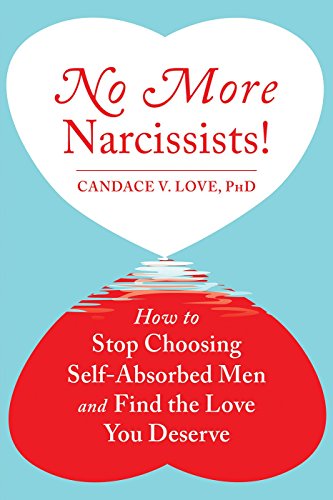
This week on Relationships 2.0 my guest is Candace V. Love author of No More Narcissists!: How to Stop Choosing Self-Absorbed Men and Find the Love You Deserve

About the book:
Why do some women date, or even marry, narcissistic men—over and over? In this provocative book, a clinical psychologist and expert in narcissism offers 7 secrets to help women finally break free from their attraction to narcissistic men.
Do you keep finding yourself in relationships with narcissistic men? Is your boyfriend or husband solely focused on fulfilling their own needs and unable to see things from your perspective? If you’re tired of dealing with a self-absorbed partner and are ready to be treated with kindness, respect, and sensitivity, this book is for you.
In No More Narcissists!, psychologist Candace Love provides a road map for women to finally get the love they deserve. Using skills based in cognitive behavioral and schema therapy, you’ll gain an understanding of why you’re attracted to narcissistic men, how you can avoid being drawn in by a narcissist’s initial charm and magnetism, and how to heal so you can finally move on to healthy relationships.
You’ll find out how the basic principles of schema theory—core beliefs about ourselves and our environment that we acquire in childhood and adolescence—can play an important role in why you’re attracted to narcissists and seek them out. Also included are targeted exercises and techniques that will encourage you to examine your past relationships and take meaningful steps to promote self-care and healing.
Isn’t it time you broke the cycle of hurt, frustration, and pain that comes with loving a narcissist? This book will show you how to let go of these destructive relationships once and for all, love yourself unconditionally, and find the love you deserve.
About the author:
As a licensed clinical psychologist, Candace V. Love, PhD, is passionate about helping women avoid narcissistic relationships. As founder and president of North Shore Behavioral Medicine, which has offices in downtown Chicago and Grayslake, IL, Love uses evidence-based techniques derived from cognitive behavioral therapies, including mindfulness and schema therapy. Much of her spare time is divided between the least narcissistic of creatures—namely animals. She enjoys riding horses and rehabilitating feral cats in the woods behind her home, and indulging in the next foodie find—whether it be a gourmet meal, vintage wine, or craft beer.
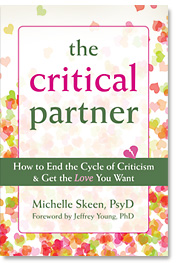 My guest for this week is Michelle Skeen… yes, I will be host and guest! I will also have a close friend of mine on my show (I will reveal his name at the beginning of the show). Over the last month, I have been having frequent conversations with people about the subject of my book The Critical Partner. It has become clear to me that there are many people who feel trapped in the role of the “critical” partner and they truly want to end the toxic role that they play in their relationship. So, I will be discussing the primary schemas that trigger this behavior as well as the alternative coping strategies that can help them move on from their maladaptive behavior.
More about The Critical Partner
I have heard from many “critical” partners who are wondering if my book can help them. The answer is…YES! First, I want to say congratulations for recognizing that you are in the role of the “critical” partner is your relationship. The “vulnerable” partner is not the only person who is suffering with the relationship dynamic that I address in my book. Identifying your schema is an essential part of understanding what is driving your critical behavior toward someone who you love. Gaining a different and better understanding of yourself and your partner is powerful. The chapters containing alternative coping strategies will provide you with healthy ways to communicate with your partner. Change is difficult, but I feel very strongly that the rewards are worth the challenges that you will face. I encourage you to sign up for the journal so that you can keep a log with your thoughts and feelings. It will help you track your progress. Feel free to contact me with any questions.

New York Times Sunday Styles Section
“Love, Lies and What They Learned” by Stephanie Rosenbloom
Online dating is allowing scientists to explore that age-old question:
Why do people fall in love?
Here are some of the findings in the article that I found interesting:
— Many daters would rather admit to being fat than liberal or conservative
— Of the romantic partnerships formed in the United States between 2007 and 2009, 21% of heterosexual couples and 61% of same-sex couples met online
— 81% of people misrepresent their height, weight or age in their profiles
— On average women describe themselves as 8.5 pounds thinner in their profiles than they were
— Men shaved an average of 2 pounds off of their weight but they lied by a greater magnitude than women about their height
— Women’s profile photographs were on average a year and a half old. Men’s were on average six months old
— Liars tend to use fewer first-person pronouns. Liars use more negative words like “not” and “never.” Liars use fewer negative emotion words like “sad” and “upset,” and they write shorter online essays
— Lying is partly a result of tension between the desire to be truthful and the desire to put one’s best face forward
— Some daters bend the truth to fit into a wider range of search parameters; others unintentionally misrepresent their personalities because self-knowledge is imperfect
— Women want men who are tall and wealthy
— Women prefer men who are slightly overweight
— Men prefer women who are slightly underweight and do not tower over them
For those of you who have used online dating, are these findings consistent with your experience?
Wall Street Journal
“Help Wanted: A Good Therapist” by Melinda Beck
I think that this article will resonate with many of you who have experience with therapists and it will provide helpful suggestions for those of you who are thinking about starting therapy or looking for a therapist.
According to a 2007 statistic, 9 million Americans or 3% of the population had out-patient therapy.
Finding a therapist who is a good fit can be challenging. I was reminded of this during a recent conversation with someone who was recounting his therapist experiences and what has worked for him including coping strategies that he still utilizes when he is struggling.
In the article, Melinda Beck explains that “therapy can be painful, particularly if you are confronting fears or reopening old wounds. So, if you have a therapist who is “too hard” and “you dread every session or feel the therapist isn’t empathetic, it may be a bad fit.” Conversely, a therapist who is “too soft” may not be a good fit either. “The therapist shouldn’t be your best friend. Supportive listening can be soothing, but if the therapy doesn’t challenge your thinking and push you to change, you may not make much progress.” The most successful therapy—“the right fit”—occurs when it is collaboration—“the patient and therapist often agree on a diagnosis, share insights and set measurable goals. You should feel connected intellectually and emotionally and comfortable enough to make changes.”